Showing posts with label Screenplay. Show all posts

Sunday, December 20, 2009

Braving New Trails to the Web and Beyond with Screenwriter Aaron Mendelsohn

Sisyphus had it easy compared to us screenwriters.

If the Writer’s Guild Strike of 2007 taught us anything, it’s that you don’t have to wait for the studios to green light your project to get something made. Joss Whedon’s Dr. Horrible’s Sing-Along-Blog and Felicia Day’s, The Guild are two shining examples of this.  Truth is, all you really need is a script, a cameraman, some actors, a grip, a director, a coordinator, a production manager, a best boy, a make-up person, some P.A.s, maybe a driver, equipment, an editor and most importantly, craft service. 

You’ll also need a place to display your production once it’s complete. 

Enter the internet. That mystical, magical cloud we can neither see, nor touch but we’re convinced will either be the savior of Hollywood or its downfall. The jury is still out on that one. The point is this: it’s virgin territory and for those of us willing to take a risk and put ourselves on the line, it’s a fresh proving ground; an opportunity for writer/creators to finally exert greater control over their own content while bringing it directly to the consumer.  On the other hand, it’s also a cheaper way for the studios to see what we’ve created without paying us anything in advance. 

New media equals new paradigm.

So is new media really just old media with a fresh coat of paint or is it old media’s salvation? Although it’s still too early to predict the quality of content that will be created by the collision of old and new media, one thing is clear: it’s gotten a lot of us writers out from behind our keyboards and into the production end of the game. The question is, will it level the field or simply prove to be another wasteland?  Conventional wisdom tells us it’s too early to tell, so I’ll have to get back to you on that one.

In the meantime, one writer I know who is currently exploring this wild New Frontier is Aaron Mendelsohn. Aaron recently took time out of his busy schedule to answer a few quick questions on writing for the big screen and for the internet.

A working screenwriter for over fifteen years, Aaron currently sits on the Board of Directors for the Writers Guild of America West.  During the recent Writers Strike, Aaron brought together a group of top writers from Hollywood to launch Virtual Artists, Inc., a writer-owned studio that produces sponsor-supported "water cooler" entertainment for the Web.  Earlier this year they completed their “A” round of financing and will be launching their first shows in 2010.


Previously, Aaron co-created the AIR BUD movie franchise and co-wrote the first two films.  Among his other writing credits are the Lifetime movie CHANGE OF HEART, the Fox series “KINDRED: THE EMBRACED” and the independent feature CHAPTER ZERO, which he also directed. 


Jeffrey Berman: What was your first break as a writer and what did you learn from it that you brought to your following writing assignments?

Aaron Mendolsohn: My first break was setting up a pilot for a drama series that was based on a book my old partner and I optioned.  The pilot never went anywhere, but I learned how meaningful it was to have the credibility of a book backing you up.  And this was back in 1993. These days, having some kind of pre-existing intellectual property is practically a requirement.


JB: There’s an old adage in the film business, “Never work with animals or children.”  Is the same true when it comes to writing for them?  Do you approach scenes differently when writing for a dog, like in your script for Air Bud?

AM: I think writing for children and animals is very liberating in that you don't have to conform to all the restrictive logic and behavior that comes with writing adult characters (unless you're Judd Apatow, in which case you write your adults as if they're children).  And it's nice not to feel you have to make every line of dialogue Sorkinesque.  The challenge, when writing about kids or dogs, is to not be too precious.  No one likes precious.  And avoid anthropomorphism.  Dogs don't smile, they don't dance, and they don't raise their eyebrows.  When we were writing Air Bud, our Post-It note on the computer was: Everything the dog does, he does it for the boy.  He doesn't play basketball because he's some ball-jonesing canine Michael Jordan, he plays it because the boy he loves plays it.


JB: When you’re working on a story and you creatively hit a wall, what techniques do you use to break through and finish the script?


AM: I just write through it.  Get down whatever hideous blather spills out of my fingertips, and then I "fix it in post."


JB:  You recently created a new media company called, Virtual Artists that produces sponsor supported content.  Is writing for the web different than writing for Film and TV, and if so, how does it differ?

AM: Films and TV are a lean-back experience.  Web content is a lean-forward experience.  We try to build interactive components in and around our shows, giving viewers the option to click, interact, respond, share and sometimes even control the narrative.  It's the evolution of storytelling.  Sponsors like this sort of engagement because it increases the number of touch points with viewers.


JB: What advice would you offer to up-and-coming writers who want to work in the industry?

AM: Get the rights to something that has a pre-built audience – book, graphic novel, magazine article, 1970s TV show – because, sadly, in this era of corporate bottom lines, no one's buying original stories anymore.

Tuesday, December 1, 2009

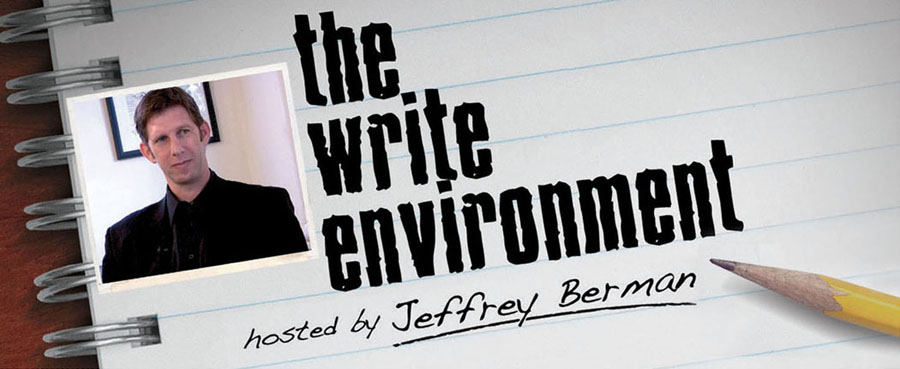
Getting it write with Jeffrey Berman, the host of The Write Environment

Okay, I know it's been a while since I posted my last interview. Some of the fault is mine because I've been busy producing a project I wrote. But I can't take all of the blame. I'm currently waiting for three new interviews to come in, which I'm assured will be any day now.

So...

In the meantime, I thought this might be a good opportunity to reprint an interview that I did on the The Write Environment for Talking With Tim, which is a great site where you'll find pop culture interviews by Tim O'Shea. Check it out... but not until after you've read my interview first.

Jeffrey Berman on The Write Environment

When the writer’s strike happened in late 2007/early 2008, writer Jeffrey Berman was looking for a way to stay busy in a productive manner. And that’s how his new project began–The Write Environment. Here’s more details on the project: “THE WRITE ENVIRONMENT features 50-60 minute, in-depth, one-on-one interviews with some of the most lauded and prolific writers in the television industry today, including Damon Lindelof (Lost), Tim Kring (Heroes), Phil Rosenthal (Everybody Loves Raymond), Doug Ellin (Entourage), Sam Simon (The Simpsons), and Joss Whedon (Buffy the Vampire Slayer).

… each episode … takes viewers backstage into the heretofore unseen world of the writer’s room for intimate interviews that offer a rare look at these diverse writers and what inspires them. From that first idea to the finished script, the writers share their views and stories, examining their successes, failures, and everything in between.”

I enjoy the chance to interview interviewers, so my thanks to Berman for his time. In preparation of the interview, he was kind enough to allow me to view screeners of the Lindelof and Whedon interviews. My thanks also to Sylvia Desrochers for making this interview possible.


Tim O’Shea: How did you first come up with the idea of doing this series when the writer’s strike was in full swing? Do you think you would have been able to get these writers’ time if they had not been on strike?

Jeffrey Berman: The series came about as a byproduct of the Writers Guild Strike. I had co-founded a web site called UnitedHollywood.com. Our mission was to keep our members, and the public, informed as to what was really going on behind the scenes. My contribution to the site was producing live interviews from the strike line as well as viral videos to assist in getting our point of view heard. As the strike progressed we started talking about cutting out the middleman, aka the studios, which would allow us to retain ownership of our own projects. As an aside, I’ll tell you that screenwriting is the only faction of the creative world where the creators do not retain ownership or rights to their material once they sell it.
Anyway, The Write Environment felt like a natural progression from what I was already doing at the time. Plus, how often do you really get to hear interviews with the people who create the entertainment we spend the majority of our lives watching? I saw this as an opportunity for the fans to hear from the folks behind the scenes, while offering some insight into the work process to the screenwriting neophytes out there.


O’Shea: When you saw Dr. Horrible mapped out on Whedon’s planning wall, did you have any inkling how popular his “Internet thing” (as he described it to you in passing) would be?

Berman: Nope. Who could? Of course, it was expected that anything Joss did would have an impact and certainly find a home with his fans, but I’d wager even Joss was surprised with the attention, and sales, he received from it.


O’Shea: Whedon confided how he paces while writing (not in a narrative sense, but literally walking in his writing area)–I was curious if the floor was worn where he paces–or did you look?

Berman: That’s funny, but no. There are no trenches worn into his floor. Of course, had it been a carpeted floor it probably would have shown more wear, but I related to this as I do the same thing. No trenches in my home, either.
 

O’Shea: Maybe I’ve not read or watched enough interviews with Whedon, but had he previously discussed the fact that his father and grandfather were writers much before?

Berman: Not to my knowledge. I discovered this while doing due diligence for the interview. Prior to that I had no idea he came from such a prolific family.


O’Shea: Given that most of the interview subjects are associates of yours, did you have to do much research in preparation for the interviews. Did you prep the interview subjects about what ground you wanted to cover before filming began?

Berman: Yes and no. I did research each of the writers background and reviewed their work histories but beyond that I approached the interview from two sides; As a fan and as a student. Then I split my question down the middle. Or at least I tried to. And no prep was given to the writers beforehand. Though Joss and I did have a chance to talk a little shop while the crew was setting up for the shoot. Wouldn’t you like to know what was said then? Heh-heh!


O’Shea: In all the writer’s offices you toured in the projects, what was the most impressive heirloom that you saw?

Berman: Hands down, Mr. Echo’s stick in Damon Lindelof’s office.


O’Shea: While you are an experienced writer yourself, I’m curious if you gained some writing lessons from the interviews?

Berman: Absolutely. As a comedy writer I probably benefited the most from my interview with Phil Rosenthal. As an aside, I have to tell you that it was hands down the most enjoyable of all the interviews. His comedic timing is beyond perfect. He had the whole crew in stitches for a good portion of the interview. His insights into comedic writing probably had the greatest impact on me.


O’Shea: In talking with all these successful writers, were there any common traits (for success or effective storytelling) that you observed with a majority of the subjects?

Berman: Yes, writers write. That and never sacrifice your characters for story.


O’Shea: Were any of the subjects immensely more forthcoming with information than you originally expected when you picked them to interview?

Berman: It’s really a crap shoot when you do these kind of interviews. It’s taxing to ask someone to sit and talk about themselves for over an hour at a time. ( Which is why I chose to do it in a surrounding where they’re comfortable. ) I was extremely pleased and rewarded with how generous and forthcoming all of the writers were. Not to mention insightful. Each of them has a s wealth of experience in different formats and they were all absolutely fascinating to speak with.


O’Shea: I’ll ask the question you asked some of the writers: “what makes a good writer”?

Berman: Fortitude. Writing is hard. It’s so easy to just not write. But in those time where I’m not writing, in-between the enormous guilt I feel and the sheer joy of not being chained to my computer, I’m still thinking about writing. The struggle to turn off the TV and get back to work, that’s the hardest part for me.


O’Shea: In talking to these creators about their show, did any of them instill in you a new level of appreciation of the show or its characters?

Berman: I have to go back to Phil Rosenthal because I think he broke the mold with Everybody Loves Raymond. How that show was allowed to survive for nine years astounds me. And lucky for us it did. It was on the bubble many times, but kudos to CBS for sticking by it.


O’Shea: How do you explain your encyclopedia-level knowledge of TV (ie your example of Donald Bellisario’s breaking his vow never to delve into JFK in Quantum Leap)?

Berman: I’m a fan. What can I say?


O’Shea: Where can folks get the DVDs?

Berman: Yeah, if I can put in a plug, please check out my site at http://www.thewriteenvironment.com/indexFlash.html and buy a DVD or two. Then tell a friend. Then tell your friend to buy a DVD or two… or three… Okay, I’ll stop now.

Tuesday, July 7, 2009

Write On Online / The Write Environment Query Contest Winners

Congratulations to the Winners of the Write On! Online/The Write Environment Query Contest. Thanks to everyone who entered! We had so many good submissions. Write On! Online and The Write Environment were pleased to join forces for this contest, designed to help writers jump-start their careers. Queries were judged on strength of idea, execution, and format.

The First Place Winners are:
Screenplay: Mark Golik, The Color of the Puck
Teleplay: Pj Perez, Being
Fiction: Colleen Keane, Dreamwalker
Non-Fiction: David King, The Beautiful Food Garden


And the Grand Prize Winner—who will receive a copy of Blake Snyder’s Save the Cat software—is: Mark Golik!

Mark and Pj will have their queries read by David Boxerbaum, a senior literary agent at APA. Colleen and David’s queries will be sent to Laura Strachan, Strachan Literary Agency. All First-Place Winners will receive an iScript recording of their project.


Second Place
Screenplay: Theresa Carey & Bruce Brochtrup, The Donner Party
Teleplay: Kathi Funston, Couch Cases
Fiction: Ann Wilmer-Lasky, The Seasons of Sam Rock
Non-Fiction: Jennifer Waak, How to Make your Teens WANT to do Their Homework


Second Place Prizes:
- Screenplay: Slumdog Millionaire, by Simon Beaufoy, courtesy of The Writers Store
- Teleplay: Sliders script, autographed by writer Jon Povill
- Fiction: From Crime to Crime, autographed by author Dennis Palumbo, courtesy of The Writers Store
- Non Fiction: Heliloggoging in a Sucker Hole, autographed by chopper pilot Bart Colantuono

Third Place
Screenplay: Sandy Ross, Jericho Rose
Teleplay: Roberta Annicks, Klown Town
Fiction: Jennifer Philpott, Ruth
Non-Fiction: Liz Tunnell, 101 Ways to Meet a Man

Third Place Prizes, courtesy of Barnes & Noble:
- Screenplay: Save the Cat!: The Last Book on Screenwriting You’ll Ever Need by Blake Snyder
- Teleplay: Screenwriting: The Art, Craft, and Business of Film and Television by Richard Walter
- Fiction: Writing the Breakout Novel Workbook by Donald Maass
- Non-Fiction: Thinking like Your Editor by Alfred Fortunato and Susan Rabiner

Remember: Everyone who entered is a winner! They now have a query—at least one—they can start sending out!

To your success,
Debra Eckerling, Write On! Online
Jeffrey Berman, The Write Environment