Showing posts with label Writer. Show all posts

Thursday, December 10, 2009

Josh Olson Won’t Read Your Script, But He Might Adapt Your Story


The best education I ever got as a screenwriter came from reading scripts. When I started out I read every script I could get my hands on. I still do. When I have the time. Screenplays also make the best reference material when it comes to analyzing and breaking down a scene, especially when you’re stuck on one of your own. So when you read as much as I do, you digest a lot of pabulum. But every once in a great while you come across a screenplay that sucks you in and demands to be read. A script that refuses to let you put it down, until you’ve read every word, from Fade in until The End, every time you pick it up. A History of Violence is one of those scripts for me.

Based on a graphic novel (comic book), the screenplay by Josh Olson was nominated for an Academy Award, a BAFTA, the WGA award, and an Edgar in 2007.

Which segues into this week’s topic. Adapting scripts from other mediums whether it’s a novel, a play, a comic book or a video game, is a different breed of writing. You would think it would be easy; after all, the story and character are already developed which leaves the writer the simple task of transcribing it for filming. You would think that… but it ain’t so. I know firsthand because I’ve written several adaptations, including an M.O.W based on a biography of J. K. Rowling and I can honestly tell you that it was more difficult to write than some of the original scripts I’ve written.

So when it came time to discuss adaptations I went to one of the best, and one of my favorite writers: Josh Olson.

Writer of the cult movie, Infested, Olson broke into the studio world when he sold his original script Three Guns Blue to Paramount Pictures. That led to his first studio assignment, adapting the graphic novel A History of Violence. Since then, Olson has collaborated with legendary author Harlan Ellison on an adaptation of Ellison’s “The Discarded” for the ABC TV Series Masters of Science Fiction. He’s also worked on adapting the hugely popular video game HALO for producer Peter Jackson and has adapted the Dennis Lehane short story Until Gwen, which he will also direct. Additionally, he contributed the script Have I Got Story for You to the smash hit Batman: Gotham Knights project. More recently, Olson wrote a sequel to The Wizard of Oz for Warner Brothers and has just finished adapting the Lee Child bestseller One Shot for Paramount.

He is currently developing a TV drama, Pleased To Meet Me, with the legendary guitarist Slash, and is writing the pilot for Meanwhile, a dramatic series he created and sold to producer Peter Chernin and the Fox Network. Olson can also be seen commenting on classic film trailers at Joe Dante’s website, Trailers From Hell.

His Village Voice essay, “I Will Not Read Your Fucking Script” became an internet phenomenon, getting upwards of two million hits, and is spawning a book. (I wonder who will adapt it for the screen? Ed. Note). 


Jeffrey Berman: How does the writing process differ when adapting a screenplay from a book versus working on an original idea? 

Josh Olson: Every script is its own thing, whether it’s original, or an adaptation. There are no set rules to any of them. I’ve done adaptations where I’ve only read the source material once, and I’ve done them where I had the book open in front of me every step of the way. Hell, the writing process differs from page to page, let alone project to project. 


JB: With a comic book like A History of Violence you obviously have less material to draw on then you would a novel or a series of novels like Oz. Does that allow you the freedom to develop original material or is there a fear of straying too far from the source? And does that make your job easier or more difficult?


JO: It’s not about the quantity of material. It’s about the material itself, and what you’re going to do with it. With History, I took John Wagner’s premise, title, and - god help me for using this phrase - “inciting incident,” and then leapt off and told my own story. 

The graphic novel was packed with story, it just wasn’t a story I wanted to tell. It’s a solid, smart and fun action thriller, but I was a lot more interested in getting into questions of identity. In the book, there’s never a moment’s doubt that the main character is the man the mob guys think he is. I felt like that was a missed opportunity. I thought it was a great chance to play with a classic “wrong man” scenario in which the wrong man is actually the right man. And that led me to start thinking about identity, and what it is that constitutes your “self.” Is Tom the guy they all say he is? Or is he the guy he’s made himself into?

The freedom to stray from the material doesn’t necessarily come from the material, but from your own response to it. It also has something to do with the studio’s needs, as well. If you’re doing Harry Potter, there’s a billion fans that the studio’s trying to serve. If you fuck around with the fundamentals of the stories or the characters, you’re gonna be out of a job. But with something like History, we were talking about a ten-year old graphic novel that had a very small print run. There wasn’t a market-driven imperative to be faithful to the material, and it wasn’t the enormous audience that compelled the studio to purchase the book. I found out when they hired me off my pitch that they’d had the same concerns with the book that I did, and had just been waiting for someone to come in and show them how to take it into a completely different direction.

In the end, it’s gotta be a story you want to tell. I’ve written a lot of originals, but in the end, History was one of the most personal scripts I’ve ever written.

But, like I said, it’s not about quantity of material. I adapted Dennis Lehane’s short story Until Gwen a while back. It’s a 15-page story, and it’s very spare in terms of plot and detail. It’s mostly flashes of memory, tiny details, and bursts of emotion. Very little to work with, in terms of traditional scenes, but one hell of a powerful story. For the screenplay, in order to create a feature length narrative film, I had to invent most of the scenes, many of the characters, and find a way to structure it as a visual narrative. In terms of what a screenwriting 101 teacher would call “adaptation,” there’s maybe 20 pages of the thing that are directly based on Dennis’ story. However, from the first page to the last, I was being absolutely faithful to Dennis’ story and his vision, at least as I saw it.


That’s what it boils down to for me - writing is all about taking what I see and feel and communicating it to you. In the case of an adaptation, it’s about showing you how I saw something. Because I’ll never be able to really know what Dennis’ real vision was. All I can do is tell you how I connected to it, and hoped that it touches and moves you. In the case of something like Until Gwen, I’d also hope that it would inspire you to seek out the source material and let it have its way with you as well.


JB: When adapting a classic story like Oz, how closely do you keep to the source material and how important is that for any adaptation?


JO: Like I said, they’re all different. There’s no way to generalize about any script, adaptation or original. I wasn’t adapting a specific book, but I wanted to get across some of L. Frank Baum’s magnificent characters and settings, as well as write a movie that could stand as a sequel to the MGM classic. The story I sold Warner Brothers was my own story, utilizing characters and settings and information from the first few Oz books. The hope was to come up with something that would work as a sequel to the movie as well as satisfy fans of Baum’s world.

With the exception of the characters from our world that I created, every character in the script is from Baum. But I put them into my own story.


JB: Before you start to adapt a novel for the screen, such as One Shot by Lee Child, how do you determine what parts of the story go into the script and what parts are left out? And why is it necessary to leave anything out?

JO: One Shot was a project where my mandate was to introduce a very popular fictional character to a movie audience. In that One Shot is actually the ninth book in the Jack Reacher series, it necessitated changes that would allow us to make this the first movie. But beyond that, there’s almost always some basic nuts and bolts things that have to change. In One Shot, for instance, the book is paced rather leisurely. Jack spends a lot of time going back and forth between the same two or three locations, and while it works great in the book, it would have left us with a very static movie. I had to come up with ways to combine the net result of several scenes into one, all while not just being faithful to Lee Child’s fantastic character, but also introducing him to a larger movie audience that won’t be familiar with him.      

JB: What advice would you offer to writers who are driven to find stories from other mediums to adapt as feature films?      

JO: We’re at a point in the film business where it’s harder than it’s ever been to sell originals. We could discuss and argue the reasons for this ‘til the cows came home, but in the end, it wouldn’t change that fact. Studios are heavily invested in doing material that has some semblance of built-in recognition. The trick, for me at least, has been to find material that I click with personally. In the case of Until Gwen, it was a short story that just gutted me. In the case of History, it was a premise that allowed me to take the story into an entirely new direction and explore ideas that are of deep personal interest to me. With One Shot, it was a chance to fill a void I’ve been feeling for many years - the absence of smart, American tough guy movies. The book came to me the morning after I’d shown my girlfriend the first two Dirty Harry movies, and we’d talked about how sad it was that no one was making movies like that anymore. With Oz, I got to take books that I loved as a kid and use them to comment on the state of imagination today. 

People often perceive adaptations as somehow easier than originals...  “coloring between the lines,” if you will. But if you find the way into them, the way to make them personal to you, they can be as challenging as satisfying and as difficult as an original. Sometimes more so. The vast majority of directors don’t write their scripts. In essence, they’re adapting someone else’s work, translating a singular vision from one form to another. It’s all a challenge.

Tuesday, December 1, 2009

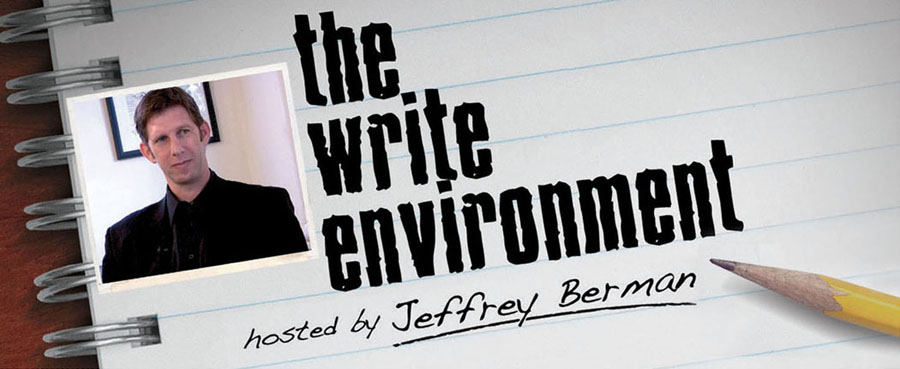
Getting it write with Jeffrey Berman, the host of The Write Environment

Okay, I know it's been a while since I posted my last interview. Some of the fault is mine because I've been busy producing a project I wrote. But I can't take all of the blame. I'm currently waiting for three new interviews to come in, which I'm assured will be any day now.

So...

In the meantime, I thought this might be a good opportunity to reprint an interview that I did on the The Write Environment for Talking With Tim, which is a great site where you'll find pop culture interviews by Tim O'Shea. Check it out... but not until after you've read my interview first.

Jeffrey Berman on The Write Environment

When the writer’s strike happened in late 2007/early 2008, writer Jeffrey Berman was looking for a way to stay busy in a productive manner. And that’s how his new project began–The Write Environment. Here’s more details on the project: “THE WRITE ENVIRONMENT features 50-60 minute, in-depth, one-on-one interviews with some of the most lauded and prolific writers in the television industry today, including Damon Lindelof (Lost), Tim Kring (Heroes), Phil Rosenthal (Everybody Loves Raymond), Doug Ellin (Entourage), Sam Simon (The Simpsons), and Joss Whedon (Buffy the Vampire Slayer).

… each episode … takes viewers backstage into the heretofore unseen world of the writer’s room for intimate interviews that offer a rare look at these diverse writers and what inspires them. From that first idea to the finished script, the writers share their views and stories, examining their successes, failures, and everything in between.”

I enjoy the chance to interview interviewers, so my thanks to Berman for his time. In preparation of the interview, he was kind enough to allow me to view screeners of the Lindelof and Whedon interviews. My thanks also to Sylvia Desrochers for making this interview possible.


Tim O’Shea: How did you first come up with the idea of doing this series when the writer’s strike was in full swing? Do you think you would have been able to get these writers’ time if they had not been on strike?

Jeffrey Berman: The series came about as a byproduct of the Writers Guild Strike. I had co-founded a web site called UnitedHollywood.com. Our mission was to keep our members, and the public, informed as to what was really going on behind the scenes. My contribution to the site was producing live interviews from the strike line as well as viral videos to assist in getting our point of view heard. As the strike progressed we started talking about cutting out the middleman, aka the studios, which would allow us to retain ownership of our own projects. As an aside, I’ll tell you that screenwriting is the only faction of the creative world where the creators do not retain ownership or rights to their material once they sell it.
Anyway, The Write Environment felt like a natural progression from what I was already doing at the time. Plus, how often do you really get to hear interviews with the people who create the entertainment we spend the majority of our lives watching? I saw this as an opportunity for the fans to hear from the folks behind the scenes, while offering some insight into the work process to the screenwriting neophytes out there.


O’Shea: When you saw Dr. Horrible mapped out on Whedon’s planning wall, did you have any inkling how popular his “Internet thing” (as he described it to you in passing) would be?

Berman: Nope. Who could? Of course, it was expected that anything Joss did would have an impact and certainly find a home with his fans, but I’d wager even Joss was surprised with the attention, and sales, he received from it.


O’Shea: Whedon confided how he paces while writing (not in a narrative sense, but literally walking in his writing area)–I was curious if the floor was worn where he paces–or did you look?

Berman: That’s funny, but no. There are no trenches worn into his floor. Of course, had it been a carpeted floor it probably would have shown more wear, but I related to this as I do the same thing. No trenches in my home, either.
 

O’Shea: Maybe I’ve not read or watched enough interviews with Whedon, but had he previously discussed the fact that his father and grandfather were writers much before?

Berman: Not to my knowledge. I discovered this while doing due diligence for the interview. Prior to that I had no idea he came from such a prolific family.


O’Shea: Given that most of the interview subjects are associates of yours, did you have to do much research in preparation for the interviews. Did you prep the interview subjects about what ground you wanted to cover before filming began?

Berman: Yes and no. I did research each of the writers background and reviewed their work histories but beyond that I approached the interview from two sides; As a fan and as a student. Then I split my question down the middle. Or at least I tried to. And no prep was given to the writers beforehand. Though Joss and I did have a chance to talk a little shop while the crew was setting up for the shoot. Wouldn’t you like to know what was said then? Heh-heh!


O’Shea: In all the writer’s offices you toured in the projects, what was the most impressive heirloom that you saw?

Berman: Hands down, Mr. Echo’s stick in Damon Lindelof’s office.


O’Shea: While you are an experienced writer yourself, I’m curious if you gained some writing lessons from the interviews?

Berman: Absolutely. As a comedy writer I probably benefited the most from my interview with Phil Rosenthal. As an aside, I have to tell you that it was hands down the most enjoyable of all the interviews. His comedic timing is beyond perfect. He had the whole crew in stitches for a good portion of the interview. His insights into comedic writing probably had the greatest impact on me.


O’Shea: In talking with all these successful writers, were there any common traits (for success or effective storytelling) that you observed with a majority of the subjects?

Berman: Yes, writers write. That and never sacrifice your characters for story.


O’Shea: Were any of the subjects immensely more forthcoming with information than you originally expected when you picked them to interview?

Berman: It’s really a crap shoot when you do these kind of interviews. It’s taxing to ask someone to sit and talk about themselves for over an hour at a time. ( Which is why I chose to do it in a surrounding where they’re comfortable. ) I was extremely pleased and rewarded with how generous and forthcoming all of the writers were. Not to mention insightful. Each of them has a s wealth of experience in different formats and they were all absolutely fascinating to speak with.


O’Shea: I’ll ask the question you asked some of the writers: “what makes a good writer”?

Berman: Fortitude. Writing is hard. It’s so easy to just not write. But in those time where I’m not writing, in-between the enormous guilt I feel and the sheer joy of not being chained to my computer, I’m still thinking about writing. The struggle to turn off the TV and get back to work, that’s the hardest part for me.


O’Shea: In talking to these creators about their show, did any of them instill in you a new level of appreciation of the show or its characters?

Berman: I have to go back to Phil Rosenthal because I think he broke the mold with Everybody Loves Raymond. How that show was allowed to survive for nine years astounds me. And lucky for us it did. It was on the bubble many times, but kudos to CBS for sticking by it.


O’Shea: How do you explain your encyclopedia-level knowledge of TV (ie your example of Donald Bellisario’s breaking his vow never to delve into JFK in Quantum Leap)?

Berman: I’m a fan. What can I say?


O’Shea: Where can folks get the DVDs?

Berman: Yeah, if I can put in a plug, please check out my site at http://www.thewriteenvironment.com/indexFlash.html and buy a DVD or two. Then tell a friend. Then tell your friend to buy a DVD or two… or three… Okay, I’ll stop now.

Monday, April 20, 2009

Mike Carey on Writing Comic Books

When I read a comic I never really look at the images, I’m just kind of right in the text.

- Kevin Smith

I like to read comics. Twenty years ago I might not have so boldly admitted that, at least not in print. Why? Because back then people would view someone purchasing their weekly fix of comics as adolescent. Not so anymore. Comics are a big business these days. When was the last time you heard someone under the age of 40 sob about how their mother threw out their comic book collection? Probably not at all. That’s because most everyone, mothers included, are aware that comics are too valuable a commodity to be disposed of so casually. Of course, they always have been to a small group of aficionados. But times change. And for comics I’d say that turning point came somewhere around the time of Superman’s death, back in 1992 when everyone rushed out to by one of the million copies printed and packaged in plastic wrap. Since then, comic books have become as acceptable and mainstream as the New York Stock Exchange. That’s when I stopped collecting. I still buy comics, but not with an eye toward investment. To be honest, I do it for the same reason millions of people tune into soap operas everyday… I like the stories. The truth is I sold the bulk of my comic collection a long time ago.

But not all of them.

There are a few “complete sets” I just couldn’t bring myself to part with. Not for monetary value, but for literary reasons. Neil Gaiman’s critically acclaimed The Sandman series tops the list. Published by DC Comics under their Vertigo imprint, it chronicled the tale of Dream of The Endless, who ruled over the world of dreams in 75 issues from 1989 until 1996. I had the good fortune to meet Neil back when the series first premiered and was lucky enough to get an original drawing from him before he became the icon he is today.

The other collection I keep stored in the back of my closet is Mike Carey’s incredible spin-off /sequel to The Sandman series, Lucifer. Like Gaiman, Carey has a perspective all his own. He is an engaging story-teller who understands that a story is driven by the sum of its parts and not just the individual pieces that it’s made up of. Character, conflict, emotional beats and compelling back stories are meticulously taken apart, thoroughly examined, then reassembled to form a unique, comprehensive and engrossing story that is nothing short of epic. And, not unlike The Sandman, Carey’s Lucifer ended after a short 75 compelling issues.

So if you want to learn about writing comics you can’t do much better than to talk to Carey himself.


Author of the Felix Castor novels, and of a great many comic book series, Carey is currently writing X-Men Legacy for Marvel and The Unwritten for DC Vertigo Comics. His comic series The Stranded has been optioned by the Sci-Fi Channel, and he has a movie, Trinity, in development with UK producer Slingshot Pictures.


Jeffrey Berman: The easy first question is always, “How did you get your start writing comic books?” but I’m equally interested in what keeps you working in the business now that you’re a successful novelist/screenwriter?


Mike Carey: As far as breaking in goes, I did it slowly and by gradual degrees. I wrote reviews and then longer articles for UK fanzines, and only plucked up my courage to submit a pitch when a guy I already knew in that context became the editor of a very short-lived line of comic books - called Trident because the start-up money came from the comics distributor Neptune. They ended up accepting two pitches from me, for a very derivative post-Watchmen "let's deconstruct superheroes" book and a psychological horror miniseries. But then they went bankrupt before they could publish either project, and I was out in the cold again. Several more years of sniffing around the American indie scene followed, before I finally got commissioned to do the SANDMAN PRESENTS LUCIFER mini for Vertigo. That would have been in 1998, by which time I'd been writing for most of a decade.


Why do I carry on writing comic books? The short answer is that I still enjoy it. Comic books are a narrative form that I'm really comfortable with, and that really means something to me. I'd be more likely to drop screenwriting, which I do very intermittently, than to drop comics, which have been at the centre of my creative life for almost two decades now. I like to think of myself - pretentiousness alert - as a storyteller, first and foremost - I work in a lot of different media, and I've gotten used to the interplay between the medium and the message in all those different contexts. But everyone has a centre of gravity, and mine is comics.


JB: There must have been a great deal of pressure on you following Neil Gaiman’s successful Sandman series. How did you prepare for Lucifer and did you always know how and where the series would end?


MC: I didn't experience it as pressure. When I was commissioned to write Lucifer, what I mainly felt was drunken rapture. Sandman was one of those books that redefines - for a time, in a given context - the rules of storytelling. It opened my eyes to a lot of things about narrative structure in comic books that I'd never consciously thought about before. So getting to play with those characters and to move them about on the same stage, so to speak, was a wonderful thing.


I did the forward planning meticulously - more so than for any subsequent series. My initial pitch for the ongoing book covered about three years' worth of stories, going almost to the end of the "Divine Comedy" arcs. Beyond that, I was hazier, but I always knew where the story was going to end: that there would be a second war in Heaven, with Lucifer fighting on the side of the angels, and that following that there would be a new God seated in primum mobile.


Inevitably, though, many new ideas suggested themselves as I was writing, and some stories eventually got added into the book that I had no conception of when I started out. All the Gaudium stories, and all the centaur stories, would fall under that heading. I just liked the characters and kept revisiting them.


JB: Do you approach writing genre comics, such as Hellblazer or Crossing Midnight , any differently than you do a superhero comic like The Fantastic Four or X-Men and if so, how?


MC: No, I think my overall approach is probably the same. Where there is a difference, it relates less to genre, more to the question of what's come before and how I'm going to launch off from that existing continuity. With Crossing Midnight, I was able to make all the rules for myself because it was a creator-owned book: the same with Faker, My Faith in Frankie, even Spellbinders (although Spellbinders isn't creator-owned). That freedom can be very refreshing. With Hellblazer and X-Men, there was a lot of backstory to be acknowledged, and the starting point for my own planning was "well where do I go from here?" With "here" being the point that the story had already reached under my predecessors. Very few writers ever go forward along exactly the same trajectory that was being mapped out by the previous creative team, but I always like to anchor myself in continuity rather than to slash it to ribbons on principle. With Hellblazer I put my anchor in the very brief Warren Ellis run, and used a lot of the supporting characters he'd added to the canon - then I started adding my own. With X-Men, I was allowed to pick my own very bizarre team, and the stories flowed very easily - first of all, explaining how this heterogeneous cast came together, and then letting their personalities and interaction guide the narrative.


JB: Take me through your process of writing a comic from start to finish? Do you work from an outline? Pad and paper versus computer? Any deities you offer up a sacrifice to before you begin?

MC: I tend to start with a beat sheet - a list of scenes, either roughly costed for page count or else just listed in sequential order. There are some basic assumptions I'll make here. One of them, which is going to sound a bit mechanical, is that a 22-page comic will have roughly 11 scenes. I'll allow myself to go a couple under or a couple over, but generally no more than that. Some comics don't lend themselves to being chopped up in that way, but it's a reasonable starting point for most. Of course, you don't necessarily stick to the plan once you start writing, but it's still good to have one.


The second stage is a very idiosyncratic one. I draw page roughs. They're very crude, rough-and-ready little sketches, but they allow me to do two crucial things - to decide on the POV and framing for each panel, and to write all the dialogue and caps. This is the most creative part of the whole process: all the most important decisions are made here, and it typically takes me a day and a half, maybe two days, to finish the roughs.


Then I type up the script, usually deviating from the roughs in a number of significant ways, but sticking to them for easily three-quarters of the time. This only takes a day, because the hard part is already done: a lot of the time, I'm just transcribing what's already there in the roughs.

No sacrifices, but a lot of strong coffee and the occasional Snickers bar.


JB: Was there any trepidation on your part when you took over writing chores on Hellblazer? Did you feel weighted down by Constantine’s lengthy history and if so, did that have any effect on you bringing your own perspective and unique narrative to the book?


MC: It's strange to look back on this, but the biggest worry I had was whether I could handle the workload. I was writing Lucifer by then, so I had one comic script to submit on a monthly basis - and I didn't see how anyone could write TWO comics in a month! So initially, when Will Dennis offered me the gig, I declined with thanks. Fortunately, Will said he wouldn't take my first answer: he'd let me think about it for a day or so, then ask again. The second time, I said yes.


That was in 2002. By the end of 2004, I was happily handling four comics projects in a month, with occasional spikes up to five or six. It never felt like a strain.


As for the backstory, well, see above. I think there's a sense in which everyone writes John Constantine as themselves. Certainly, every writer has their own unique perspective on the character, so he changes a lot from one incarnation to the next - while still remaining recognizably himself.


JB: What advice would you offer to aspiring comic book writers just starting out?


MC: There are a lot of things that will make it more likely that your work will get picked up. One is presentation. Use a proper script format, clear and legible and consistent, with a header or footer that has the title of the project, the issue number, maybe your name and contact details. There are lots of examples out on the web now, and many more included as value-added features with trade collections or in "director's cut" reprints of popular books. I'd say brevity is a virtue. Don't skimp on necessary detail, but don't fill out your script with unnecessary verbiage. Novel-length scripts are only good if you're Alan Moore: most people aren't.


Check online submission guidelines if you're in doubt about what to send with a pitch. Some companies have fairly precise rules, but they're mostly posted right up there for you to see.


Do your research: make sure you're sending your precious pitches to people who might actually be interested in them. I once sent a Superman pitch to Karen Berger - after she'd already founded and moved wholly into the Vertigo imprint. Address submissions to a named editor, and follow up with an email or phone call after a decent interval of time. Don't bug the editor endlessly: if you become irritating, it's game over. Be persistent, but only within the bounds of politeness.


Don't assume that you can abridge the process and start at the top. Sometimes you can, but more usually not. DC and Marvel both prefer you to have a track record of published work before you approach them. The exceptions tend to be for people who've already made their names in another area outside of comic books and probably have transferable skills.


But the two biggest things are the two most obvious: read a lot and write a lot. If you read passionately and love stories, it's easy to take that love one stage further and think about what precisely floats your boat: what distinguishes a passable story from a good one, and a good one from a great one. It's important to think about how stories work and to expose yourself to a lot of them - not to copy them, although you may start out by doing that in some respects, but to get a feel for their internal geography.


And write, write, write until your eyes cross and your keyboard melts. Writing is one of those things - like sex, say, or riding a bike - that you get better at by doing it. That's especially true if you then show what you've written to other people, get feedback on it, and take the feedback seriously. You can't do this alone. You need a test audience. More specifically, you need a test audience who are prepared to be honest with you.