Showing posts with label The Write Environment. Show all posts

Thursday, February 25, 2010

Juliet Landau Takes Flight

Juliet Landau is a renaissance woman. She acts, writes, directs, produces, edits and for all I know, dances a mean tango, too.

So when Gary Oldman agreed to direct a music video shot entirely on Nokia cell phones for the Jewish Hip Hop band, Chutzpah he realized his three-day odyssey needed to be documented in a behind the scenes “making of” video. With that in mind, Oldman turned to first time director, Juliet Landau to capture his unique vision.

"Juliet Landau is an exceptional talent! I entrusted Juliet to make a documentary film about me and I am thrilled with the results! TAKE FLIGHT is a special film that shows me in a very different light. I will work with Juliet again without hesitation."
                                                         -Gary Oldman

What began as a five-minute behind the scenes “making of” film quickly morphed into a 25-minute documentary that is at times oddly transfixing, very insightful and mostly a joy to watch.

So why are we talking about a documentary in a blog that’s dedicated to writing? Because films don’t happen in a vacuum. Dramatic screenplays don’t write themselves and documentaries aren’t just cut together without a lot of pre-production.

Documentary filmmakers, like their screenwriting counterparts, endeavor to tell strong character-driven stories with tension, and a narrative arc that keeps the viewer engaged from the beginning to the end. Unlike writers of fiction, documentarians can’t invent characters and plot points, so it is incumbent upon them to instead find these in the subject they choose to shoot. In many ways editing a documentary is very similar to editing a first draft of a script. The struggle to decide what to include is as equally important and difficult as deciding what to omit.

In a documentary, shots, scenes, and sequences help to convey narrative information about time, place, events, people, emotion and point of view. Obviously the better you know your story before you shoot, the better prepared you’ll be to find those key moments as they occur.

In the weeks leading up to the release of TAKE FLIGHT, Juliet engaged in a whirlwind of interviews, marketing strategies and updates via social media, all the while editing a viral campaign in hopes that it would be ready in time for its target release date, February 25th. Juliet was kind enough to take a few minutes out of her busy schedule to discuss the process of creating a first time documentary.


Jeffrey Berman: Prior to shooting TAKE FLIGHT, how did you approach the story you wanted to tell and did the final product reflect your initial concept? If not, how did it differ?

Juliet Landau: Well, first of all, Gary Oldman was about to direct a music video for the Jewish Hip Hop band, Chutzpah, which he was shooting entirely on cell phones. He asked me to direct the “making-of.” After I agreed, I realized that although I have been in many a “making-of,” I had never actually watched even one. I buckled down and watched tons of film “making-of’s,” music video “making-of’s,” documentaries and director commentaries. I made notes about the elements that I found most interesting and riveting. The thru line of those elements began to emerge. It became clear that I was interested in seeing an artist at work, being a party to his/her process. I knew that I was going to have three cameras, and while I would catch all of the action, I was certain that I would stay on Gary as much as possible. I had 50 hours of footage that I condensed into a 25-minute film, which includes Gary’s music video at the end. I watched all 50 hours three times through. Gary operated one of the “cell-cam’s” which afforded us an extremely rare POV. It’s as if the viewer is inside his head, seeing through his eyes. It was while watching the footage that it evolved. I asked Gary if I could make a short documentary and he gave me his blessing to do so.


JB: What was the development process like on TAKE FLIGHT? What kind of shooting outline or detailed treatment did you write to serve as a blueprint for the documentary?

JL: I made a timeline of all of the shots I wanted to be sure to get. But, I also wanted to be open to go with the surprises as they presented themselves. While I did shoot some direct to camera interviews, I always felt it would be more in the vein of verite filmmaking. My outline was two pages long. I would check stuff off as we got it, for instance, having each of the girls sing the Red Rover song. It was always my intention to try to capture Gary’s incredible sense of humor.

JB: How did the editing process affect the story you initially set out to tell with TAKE FLIGHT?

JL: Initially I thought I’d cut the cell phone footage in here and there with the HD footage being the basis for the timeline. But when I saw the unique perspective I had with the phone footage, I decided it had to be the reverse. I intercut it in the following way: first we get peppered glimpses, then longer, more expansive pieces, and by the end, the viewer is completely released into Gary’s view. While it all cuts seamlessly and fluidly, I decided to keep the cell footage 4X3, and everything else 16X9. Not only does it preserve Gary’s framing, it makes it clear to the audience when we are “looking though his eyes.” The music video is very cutty. I wanted to linger on and relish the beauty of those shots. The film starts as a chronicle of the shoot, but it becomes something more. There is a point where Gary says, “I’m just trying to find the right moment…” I think that is the pursuit of every artist, searching for the moment where everything gels, and takes flight.


JB: How involved were you with Gary Oldman as he was shooting his video? Was there any discussion with him prior to shooting about shots you wanted or were looking to get? 

JL: He basically gave me free reign so I was really nervous when the day arrived to show him my cut. I went to his house with my computer, the hard drive and a thick spiral notebook, to get his notes. I thought sitting there while he watched it was going to be the most interminable 25 minutes of my life. But I started the film, and low and behold, it was fun! He was completely engaged and laughing throughout. Afterward, I had my pen poised, ready to take copious notes. But he only gave me one note. A note about moving a sound cue, one of his comments, to a bit later, and that was it!


JB: As a first time documentary writer/director what did you learn from producing TAKE FLIGHT and how will this affect the next project you decide to shoot?

JL: Just like with acting, and with life for that matter, it is good to trust your instincts. They always lead me in the right direction. I was lucky to work with incredibly talented, skilled people, which I absolutely will do on my next shoot. Also, preparation is key. When I co-directed the HERO music video for Godhead or with the viral campaign I am putting together for TAKE FLIGHT, preparation makes all the difference in the world. I prepare for everything I work on, whether it’s acting, still shoots, directing, you name it, and it always pays off. I find the more prepared I am, I have a fluidity and ease to flow with the unexpected. I’d like the next project to have a real budget. It is hard to work around people’s paying gigs when you are pulling in favors. The process gets protracted and tiring. But either way, in the end, it is amazing to have a vision and to bring it to life!

You can watch Take Flight at Juliet’s official site.

Thursday, February 11, 2010

From Batman to Star Wars: Writer Steven Melching Gets Animated

In many respects, animation writing is the bastard step-child of TV and screenwriting. When it comes to the act of writing there is absolutely no difference between writing a script for an animated half hour series or that of a live action sitcom. There just isn’t. Any way you twist the glass it’s still writing. Yet for all the strides the Writers Guild of America (WGA) has made towards protecting TV writers, they still don’t cover animation writers. There is no reasonable or logical explanation for it; it’s just a fact of life. Becuse of this the majority of animation writers are denied the same benefits as their cousin live action writers (with the exception of some prime-time animated series). Most animation writers receive no residuals, spotty health coverage and often times little or no recognition for the job they do to entertain us.

And yet, knowing all that, given the opportunity I would like to write an episode of an animated series somee day. It’s practically the only genre of screenwriting I have yet to tackle. I’ve written feature scripts. I’ve written TV movies, spec’d a few sitcoms and even wrote a rom-com pilot. But I’ve never written a script for an animated series. The reason lies partially in the reality that as low as feature film screenwriters are on the Hollywood totem pole, and believe me, we’re pretty low, animated writers are at the bottom of the totem, deep beneath the ground.

It’s probably for this reason I’ve never had an agent or a manager push me in that direction. But I’m still a kid a heart and I still love cartoons. So to be able to write one would be a fantasy for me. Not something I would do for the money and certainly not for the fame but something I would do for love of the art. I might not be able to retire on it but you can bet your bottom dollar I’d be as proud of it as anything else I’ve written.

The beauty of writing animation is there are very few limitations. Anything the writer can imagine can be filmed without fear of changes due to cast or budget limitations because there simply aren’t any. Of course, it would probably help if I had more contacts in the animation world.

I have one now. Steven Melching . Some of the more recognizable series Melching has been associated with include: X-MEN, GODZILLA, AVENGERS, MEN IN BLACK, THE MUMMY, LEGION OF SUPER-HEROES, two different BATMAN series and the crème-de-le-crème, STAR WARS: THE CLONE WARS. In the world of animation Melching is one of my heroes.


Jeffrey Berman: How is writing for animation different from writing for live action TV?

Steven Melching: That’s difficult for me to answer, because I haven’t written much live-action television. But I think there are more similarities than differences, especially given how sophisticated animated television has become in the last 15-20 years in terms of storytelling. It’s no longer strictly for children. There’s been an explosion of animated series for the adult audience, and even shows produced primarily for young audiences have strong followings with teenagers, college students, and beyond. Any stigma attached to watching cartoons after a certain age has evaporated.

There’s a misconception that you can “do anything” in animation, that the only limitation to the storytelling is the writer’s imagination. While there is some truth in that, the fact remains that animated series have budgets and schedules, just like live action. Speaking parts still have to be cast and actors paid, and even though actors can perform as many as three voices, we can only afford to hire so many. Each new character, prop, vehicle, and location has to be designed by an artist, which costs money. And some things are just very difficult and/or expensive to animate convincingly, so we try to avoid them. Things like crowd scenes. There might actually be more differences between writing for cell animation versus computer animation than between animation and live-action. Or between writing gag-driven animation versus action/adventure animation.

One thing we tend to do in animation is “direct on the page,” which is discouraged to varying degrees in live-action. Sometimes it gets as detailed as describing every single shot in a scene. So animation scripts are generally much longer than live-action scripts. For example, a script for a 30-minute action/adventure show is usually between 32-36 pages long, but written in the same single-space format as a live-action movie.
And I’m really only talking about half-hour “story driven” animated series. Other cartoons don’t really even have scripts at all. They start with an outline, but are “written in storyboard” by the story artists and director.


JB:. How has your style of writing changed from early in your career when you were writing for The X-MEN to today where you’re currently working on BATMAN: THE BRAVE AND THE BOLD?

SM: If anything, my style has gotten looser and more readable as I got more comfortable with the medium. I think my craft and confidence has improved to the point that I can use fewer words to say the same thing. (Not that you can tell by my long-winded answers to these questions.)

When I started on X-MEN, I loved to write the action sequences. I took great pleasure in plotting out the mayhem blow-by-blow. But as the years pass I find that stuff less and less interesting to actually write. Don’t get me wrong, I love action. I love dreaming up an inventive setpiece. And I love figuring out how to advance story, explore character, and illuminate theme through action, but actually sitting down to type it all up is sometimes tedious.


JB:  How much freedom do you have when it comes to story and character development for a series like STAR WARS: THE CLONE WARS? And what, if any, are the limitations? 

THE CLONE WARS is a unique case. I’ve been lucky enough to have the opportunity to work on shows based on beloved properties with long histories and devoted fandoms (X-MEN, BATMAN, HE-MAN, TRANSFORMERS), but never one where the original creator was actively involved. I mean, George Lucas is personally involved in every stage of the process, from approving (and often generating) stories, giving notes on scripts, supervising the design, to shaping the final episodes in the editing room (which can involve a lot of rewriting and restructuring). Also, the director is king at Lucasfilm. That’s just George’s filmmaking philosophy. In large part the script serves as a means to generate film to edit, which then illuminates what elements need to change. It’s a fascinating process.

As a writer for CLONE WARS, I can’t say I had much freedom in terms of the big picture, for several reasons. George Lucas and supervising director Dave Filoni have very specific goals in mind for the stories. And since the series takes place between two movies, there’s only so much development that can take place, at least as far as the major film characters are concerned. Where there is latitude is with the supporting characters, as well as the ones that were created for the show. As a writer, my challenge is to capture that very specific STAR WARS tone, find fun ways to keep the story moving, and invent new little details that are surprising.


JB: In animation what comes first, story or plot? And why?

SM: Story, for sure. To me, story is the broad strokes, the beginning-middle-end, the journey of the characters. Plot is the logic and mechanics required for the story to track and make sense. With some shows, CLONE WARS in particular, a third element is very important: theme. In fact, that often came first. What is the story really about? The answer to that question informed every other aspect of the writing.


JB: Can you break down your writing routine on a typical episode of BATMAN: THE BRAVE AND THE BOLD?

SM: It always starts with a call from producer/story editor Michael Jelenic. He tells me what heroes and villains they want to use, and which ones they don’t. Sometimes he has an idea for a story for me to flesh out, and sometimes he asks me to pitch him ideas. Once we hone in on a story we’ll get together with producer James Tucker and we’ll try to break the story in the room. Throw around ideas, and come out of the meeting with a strong idea of what the “A” and “B” stories are, how they relate, and what the character arcs and relationships are.

Then I go home and write it up in a few pages. Michael and James will give me their thoughts on that premise, and then I’ll either revise it or flesh it out further into a 10-12 page outline that lays out the story scene-by-scene. Then it’s back to Michael and James for another round of notes. Unless we discover major problems with the story, I don’t usually rewrite the outline. I just keep the notes in mind as I write the first draft script. Then another round of notes and another draft. Hopefully the script is in pretty good shape at that point, and Michael does the final polishing himself.
 
A couple weeks later comes the best part, the cherry on the sundae: the voice recording session! It’s always a blast to go into the studio, see the cast and meet the guest stars -- and we get some GREAT guest stars. One of my favorite memories is seeing comedian Fred Willard in the booth with German horror actor Udo Kier. It’s really satisfying to hear the script come alive. As the writer, I am sometimes asked to clarify things for the director or actors, and write new dialogue on the spot. 


JB:. What is the best advice you can offer to someone who wants to break into the world of animated series as a writer?

SM: Make sure it’s what you really want to do. Don’t think of it as “slumming,” or as a way to earn some quick and easy cash, because it’s neither. Producers can smell that attitude a mile away. It’s vitally important to love animation, and understand its strengths and weaknesses.

Aside from that, I’d give the same advice to someone who wants to break into live-action. First, write a spec animation script (or two) for a current show in the genre you want to find work in, like action/adventure, action/comedy, comedy, or pre-school. Then make contacts with producers and executives any which way you can. Ask them to read your stuff. Or better yet, put yourself in a position where they ask to read your stuff. Get a job at a studio or network, or on a show as a script coordinator or producer’s assistant, so you can move in the right circles. Learn the world and the players. Read animation scripts and watch animated series. Animation is a rather small and insular community, and it can be very difficult to crack, so you have to be patient, and above all, persistent.

Monday, February 1, 2010

Neil Gaiman, Literary Rock Star and Me.


Let's be honest, there's really not much I can say about Neil Gaiman that hasn't already been said by someone else, somewhere else.  So instead of wasting time heaping praise upon the literary world's first iconic "rock star," I'll simply recount my two encounters with the widely read author and then I'll let Gaiman speak for himself.
The first time I met Gaiman was in a little comic shop I used to frequent in Sherman Oaks, California, called Forbidden Planet (sadly, it's no longer there). The Sandman had been in print less than a year and Gaiman was several years off from becoming the superstar he is today. Thus, I found him seated alone at the back of the store, making his rounds, promoting the book from store to store, city to city and God knows where else. There he sat as the rush of comic collectors wound their way around the store pawing through the week’s comics deciding which ones to buy and which they were just going to just read off the rack.
Being an avid comic book reader, I had stumbled across The Sandman when it first hit the stands earlier that year so I knew how prolific that guy in the dark sunglasses and leather jacket was. I headed home and retrieved my back issues, and then made my way back to the back of Forbidden Planet. Gaiman and I spoke for several minutes, then he signed my books.  On my way out I picked up a copy of Sandman # 8 that DC had sent along with Gaiman as a giveaway.  Apparently there was a misprint in the run and they were earmarked to be destroyed. Rather than waste them, DC decided to give them away for free.  I’m told its quiet rare.  Only 800 were printed.  I got one.
My other cool Gaiman story took place several years later. My wife at the time, (which is code for my now “ex-wife”) knew I was a fan of The Sandman books so she wrote to Gaiman and asked if he would draw a sketch for me as an anniversary gift.  Needless to say, he did.
I’m guessing it’s probably rare too.

Gaiman was kind enough to take a few minutes out of his busy schedule to answer some questions for The Write Blog.  If you don’t know who he is, you’ve led a very sheltered existence. Back when he first created The Sandman he was simply know as an English comic book writer. These days he is referred to as an author of science fiction and fantasy short stories and novels, graphic novels, comics, audio theatre, and films. He has won numerous awards, including the Hugo, Nebula, and Bram Stoker, as well as the 2009 Newbery Medal and is the author of Stardust, American Gods, Coraline, and The Graveyard Book. And of course, his most notable work to date remains The Sandman series.

Jeffrey Berman: I read that you once said, “I'm not really an adult novelist, or a short story writer, or a screenplay writer, or a poet or a comic writer or a radio play writer or a playwright or a children's author. If I'm anything, I'm a storyteller.” What do you see as the difference between a writer and a storyteller?
Neil Gaiman: These days most storytellers are writers; not all writers can (or do) tell stories. I think what I was trying to get at there was that for me the story is the most important thing. The medium for the story is less important, except as far as it makes the story shine, like a setting for a jewel.

JB: In what way does your writing differ now from earlier on in your career?
NG: It's less exciting and less scary. When I started out there were a lot of things I knew I couldn't do, and a lot of things I only found out I couldn't do by going and doing it. And no-one was watching and nobody cared. These days there are a lot of things I know I can do (but I don't want to repeat myself) and too many people watching.

JB: Myths play such a big part in your work.  What is it about the “old stories” that appeals so much to you? What is their importance to you as a writer?
NG: I don't know why I love them (do we ever know why we love?) but I do, and they make me happy, and I try to pass on that happiness.
JB: You spent ten years crafting the mythology that went into the Sandman. What kind of research did you do before you began writing it and how much more was required on your decade long journey with Morpheus? Did you always know where the story would end or was it something you came upon as you were writing it?
NG: I knew where it would end. The research was a combination of 26-36 years of reading everything I could, combined with mad cramming whenever I had any story that demanded historical accuracy.

JB: How do you decide what medium is best suited to tell a story when you begin writing it, whether it’s a screenplay, a novel or a comic book?  Is one more challenging than the other and if so, in what way?
NG: They're all challenging. It's just a different set of challenges each time. I tend to pick based on gut feeling and what I would like to see. Sometimes I'm wrong. I kept starting ANANSI BOYS as a movie and stopping, and eventually wrote the novel and was happy.

JB: Can you share any writing tips or techniques that you use or have developed?  For instance, I’ve read that music is a big part of your writing ritual.
NG: Anything that keeps you happy and writing is part of my writing ritual: I like music, so I tend to have it playing in the background. But if I'm interested I can write in an airport waiting areas. The biggest tip is just to do it. Put one word after the other until you've made something that didn't exist before.

JB: How do you know when something you’ve written is finished or at least good enough to let go?
NG: I start thinking about the next thing. That's how I know the last thing is approaching the end.

If you’d like to know about what Neil Gaiman is up to you can follow him on his weblog at http://journal.neilgaiman.com/

Sunday, December 20, 2009

Braving New Trails to the Web and Beyond with Screenwriter Aaron Mendelsohn

Sisyphus had it easy compared to us screenwriters.

If the Writer’s Guild Strike of 2007 taught us anything, it’s that you don’t have to wait for the studios to green light your project to get something made. Joss Whedon’s Dr. Horrible’s Sing-Along-Blog and Felicia Day’s, The Guild are two shining examples of this.  Truth is, all you really need is a script, a cameraman, some actors, a grip, a director, a coordinator, a production manager, a best boy, a make-up person, some P.A.s, maybe a driver, equipment, an editor and most importantly, craft service. 

You’ll also need a place to display your production once it’s complete. 

Enter the internet. That mystical, magical cloud we can neither see, nor touch but we’re convinced will either be the savior of Hollywood or its downfall. The jury is still out on that one. The point is this: it’s virgin territory and for those of us willing to take a risk and put ourselves on the line, it’s a fresh proving ground; an opportunity for writer/creators to finally exert greater control over their own content while bringing it directly to the consumer.  On the other hand, it’s also a cheaper way for the studios to see what we’ve created without paying us anything in advance. 

New media equals new paradigm.

So is new media really just old media with a fresh coat of paint or is it old media’s salvation? Although it’s still too early to predict the quality of content that will be created by the collision of old and new media, one thing is clear: it’s gotten a lot of us writers out from behind our keyboards and into the production end of the game. The question is, will it level the field or simply prove to be another wasteland?  Conventional wisdom tells us it’s too early to tell, so I’ll have to get back to you on that one.

In the meantime, one writer I know who is currently exploring this wild New Frontier is Aaron Mendelsohn. Aaron recently took time out of his busy schedule to answer a few quick questions on writing for the big screen and for the internet.

A working screenwriter for over fifteen years, Aaron currently sits on the Board of Directors for the Writers Guild of America West.  During the recent Writers Strike, Aaron brought together a group of top writers from Hollywood to launch Virtual Artists, Inc., a writer-owned studio that produces sponsor-supported "water cooler" entertainment for the Web.  Earlier this year they completed their “A” round of financing and will be launching their first shows in 2010.


Previously, Aaron co-created the AIR BUD movie franchise and co-wrote the first two films.  Among his other writing credits are the Lifetime movie CHANGE OF HEART, the Fox series “KINDRED: THE EMBRACED” and the independent feature CHAPTER ZERO, which he also directed. 


Jeffrey Berman: What was your first break as a writer and what did you learn from it that you brought to your following writing assignments?

Aaron Mendolsohn: My first break was setting up a pilot for a drama series that was based on a book my old partner and I optioned.  The pilot never went anywhere, but I learned how meaningful it was to have the credibility of a book backing you up.  And this was back in 1993. These days, having some kind of pre-existing intellectual property is practically a requirement.


JB: There’s an old adage in the film business, “Never work with animals or children.”  Is the same true when it comes to writing for them?  Do you approach scenes differently when writing for a dog, like in your script for Air Bud?

AM: I think writing for children and animals is very liberating in that you don't have to conform to all the restrictive logic and behavior that comes with writing adult characters (unless you're Judd Apatow, in which case you write your adults as if they're children).  And it's nice not to feel you have to make every line of dialogue Sorkinesque.  The challenge, when writing about kids or dogs, is to not be too precious.  No one likes precious.  And avoid anthropomorphism.  Dogs don't smile, they don't dance, and they don't raise their eyebrows.  When we were writing Air Bud, our Post-It note on the computer was: Everything the dog does, he does it for the boy.  He doesn't play basketball because he's some ball-jonesing canine Michael Jordan, he plays it because the boy he loves plays it.


JB: When you’re working on a story and you creatively hit a wall, what techniques do you use to break through and finish the script?


AM: I just write through it.  Get down whatever hideous blather spills out of my fingertips, and then I "fix it in post."


JB:  You recently created a new media company called, Virtual Artists that produces sponsor supported content.  Is writing for the web different than writing for Film and TV, and if so, how does it differ?

AM: Films and TV are a lean-back experience.  Web content is a lean-forward experience.  We try to build interactive components in and around our shows, giving viewers the option to click, interact, respond, share and sometimes even control the narrative.  It's the evolution of storytelling.  Sponsors like this sort of engagement because it increases the number of touch points with viewers.


JB: What advice would you offer to up-and-coming writers who want to work in the industry?

AM: Get the rights to something that has a pre-built audience – book, graphic novel, magazine article, 1970s TV show – because, sadly, in this era of corporate bottom lines, no one's buying original stories anymore.

Tuesday, December 1, 2009

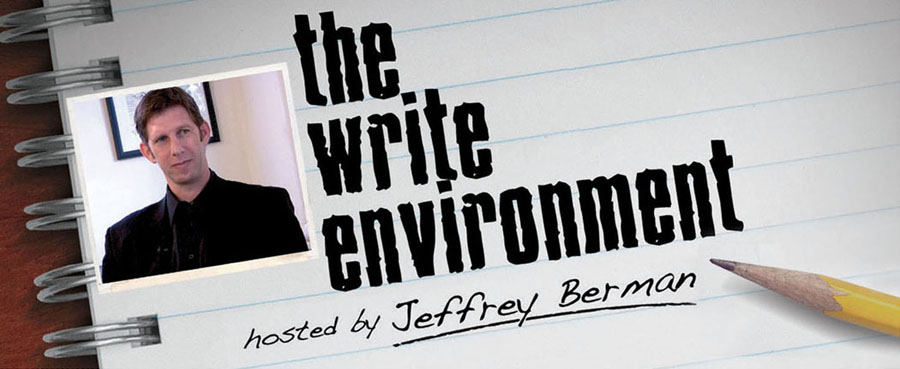
Getting it write with Jeffrey Berman, the host of The Write Environment

Okay, I know it's been a while since I posted my last interview. Some of the fault is mine because I've been busy producing a project I wrote. But I can't take all of the blame. I'm currently waiting for three new interviews to come in, which I'm assured will be any day now.

So...

In the meantime, I thought this might be a good opportunity to reprint an interview that I did on the The Write Environment for Talking With Tim, which is a great site where you'll find pop culture interviews by Tim O'Shea. Check it out... but not until after you've read my interview first.

Jeffrey Berman on The Write Environment

When the writer’s strike happened in late 2007/early 2008, writer Jeffrey Berman was looking for a way to stay busy in a productive manner. And that’s how his new project began–The Write Environment. Here’s more details on the project: “THE WRITE ENVIRONMENT features 50-60 minute, in-depth, one-on-one interviews with some of the most lauded and prolific writers in the television industry today, including Damon Lindelof (Lost), Tim Kring (Heroes), Phil Rosenthal (Everybody Loves Raymond), Doug Ellin (Entourage), Sam Simon (The Simpsons), and Joss Whedon (Buffy the Vampire Slayer).

… each episode … takes viewers backstage into the heretofore unseen world of the writer’s room for intimate interviews that offer a rare look at these diverse writers and what inspires them. From that first idea to the finished script, the writers share their views and stories, examining their successes, failures, and everything in between.”

I enjoy the chance to interview interviewers, so my thanks to Berman for his time. In preparation of the interview, he was kind enough to allow me to view screeners of the Lindelof and Whedon interviews. My thanks also to Sylvia Desrochers for making this interview possible.


Tim O’Shea: How did you first come up with the idea of doing this series when the writer’s strike was in full swing? Do you think you would have been able to get these writers’ time if they had not been on strike?

Jeffrey Berman: The series came about as a byproduct of the Writers Guild Strike. I had co-founded a web site called UnitedHollywood.com. Our mission was to keep our members, and the public, informed as to what was really going on behind the scenes. My contribution to the site was producing live interviews from the strike line as well as viral videos to assist in getting our point of view heard. As the strike progressed we started talking about cutting out the middleman, aka the studios, which would allow us to retain ownership of our own projects. As an aside, I’ll tell you that screenwriting is the only faction of the creative world where the creators do not retain ownership or rights to their material once they sell it.
Anyway, The Write Environment felt like a natural progression from what I was already doing at the time. Plus, how often do you really get to hear interviews with the people who create the entertainment we spend the majority of our lives watching? I saw this as an opportunity for the fans to hear from the folks behind the scenes, while offering some insight into the work process to the screenwriting neophytes out there.


O’Shea: When you saw Dr. Horrible mapped out on Whedon’s planning wall, did you have any inkling how popular his “Internet thing” (as he described it to you in passing) would be?

Berman: Nope. Who could? Of course, it was expected that anything Joss did would have an impact and certainly find a home with his fans, but I’d wager even Joss was surprised with the attention, and sales, he received from it.


O’Shea: Whedon confided how he paces while writing (not in a narrative sense, but literally walking in his writing area)–I was curious if the floor was worn where he paces–or did you look?

Berman: That’s funny, but no. There are no trenches worn into his floor. Of course, had it been a carpeted floor it probably would have shown more wear, but I related to this as I do the same thing. No trenches in my home, either.
 

O’Shea: Maybe I’ve not read or watched enough interviews with Whedon, but had he previously discussed the fact that his father and grandfather were writers much before?

Berman: Not to my knowledge. I discovered this while doing due diligence for the interview. Prior to that I had no idea he came from such a prolific family.


O’Shea: Given that most of the interview subjects are associates of yours, did you have to do much research in preparation for the interviews. Did you prep the interview subjects about what ground you wanted to cover before filming began?

Berman: Yes and no. I did research each of the writers background and reviewed their work histories but beyond that I approached the interview from two sides; As a fan and as a student. Then I split my question down the middle. Or at least I tried to. And no prep was given to the writers beforehand. Though Joss and I did have a chance to talk a little shop while the crew was setting up for the shoot. Wouldn’t you like to know what was said then? Heh-heh!


O’Shea: In all the writer’s offices you toured in the projects, what was the most impressive heirloom that you saw?

Berman: Hands down, Mr. Echo’s stick in Damon Lindelof’s office.


O’Shea: While you are an experienced writer yourself, I’m curious if you gained some writing lessons from the interviews?

Berman: Absolutely. As a comedy writer I probably benefited the most from my interview with Phil Rosenthal. As an aside, I have to tell you that it was hands down the most enjoyable of all the interviews. His comedic timing is beyond perfect. He had the whole crew in stitches for a good portion of the interview. His insights into comedic writing probably had the greatest impact on me.


O’Shea: In talking with all these successful writers, were there any common traits (for success or effective storytelling) that you observed with a majority of the subjects?

Berman: Yes, writers write. That and never sacrifice your characters for story.


O’Shea: Were any of the subjects immensely more forthcoming with information than you originally expected when you picked them to interview?

Berman: It’s really a crap shoot when you do these kind of interviews. It’s taxing to ask someone to sit and talk about themselves for over an hour at a time. ( Which is why I chose to do it in a surrounding where they’re comfortable. ) I was extremely pleased and rewarded with how generous and forthcoming all of the writers were. Not to mention insightful. Each of them has a s wealth of experience in different formats and they were all absolutely fascinating to speak with.


O’Shea: I’ll ask the question you asked some of the writers: “what makes a good writer”?

Berman: Fortitude. Writing is hard. It’s so easy to just not write. But in those time where I’m not writing, in-between the enormous guilt I feel and the sheer joy of not being chained to my computer, I’m still thinking about writing. The struggle to turn off the TV and get back to work, that’s the hardest part for me.


O’Shea: In talking to these creators about their show, did any of them instill in you a new level of appreciation of the show or its characters?

Berman: I have to go back to Phil Rosenthal because I think he broke the mold with Everybody Loves Raymond. How that show was allowed to survive for nine years astounds me. And lucky for us it did. It was on the bubble many times, but kudos to CBS for sticking by it.


O’Shea: How do you explain your encyclopedia-level knowledge of TV (ie your example of Donald Bellisario’s breaking his vow never to delve into JFK in Quantum Leap)?

Berman: I’m a fan. What can I say?


O’Shea: Where can folks get the DVDs?

Berman: Yeah, if I can put in a plug, please check out my site at http://www.thewriteenvironment.com/indexFlash.html and buy a DVD or two. Then tell a friend. Then tell your friend to buy a DVD or two… or three… Okay, I’ll stop now.

Sunday, October 4, 2009

Drusilla After The Fall - part 2

If you are a regular reader of The Write Blog you've probably noticed that the frequency of my posts have diminished over the last month. Take heart in that it's not for the lack of desire or that I've run out of writers to interview(I don't foresee that happening anytime soon)... the truth is I've been engaged to write and produce an educational film that has consumed a great deal of my time due to a very tight shooting schedule. That said, I hope to be back to posting new interviews as soon as next week.

In the meantime, I wanted to update you on an interview I posted Tuesday, August 18, titled, "After The Fall Juliet Landau Takes On Angel" I recently received the following note from Juliet that I promised to pass on to my readers.

Hi Jeffrey ,

How are you? I hope all is great!

I am excited to let you know that Issue 2 of the Drusilla comic I co-wrote is now out! I am attaching the two covers I designed for this issue and a few photos from the bonus photo gallery that runs inside.

Hope to catch up real soon!!

:)
Juliet

So, if you haven't done so yet, head down to your local comic store and pick up the second part of Juliet's story. And if you haven't read the first part, pick that up too. Then come back here and reread my interview with her. Then drop me a line and let me now what you thought of it. Who knows, if I find something of interest in your comments I may just pass it along to Juliet.

Tuesday, September 8, 2009

Carleton Eastlake takes us from a Farscape to The Outer Limits


I’ve been a Science Fiction fan since as far back as I can remember. I grew up watching shows like Star Trek, The Time Tunnel and The Twilight Zone. Back then sci-fi (or is it SyFy?) shows were few and far between.

One of the best science fictions series ever to air, in my opinion, was Farscape. I know a lot of Battlestar Galactica fans will probably take umbrage with that, and don’t get me wrong, I liked BG, but there was something unique about Farscape that I’d never seen before and haven’t since. The cast, the premise, the writing, the stories all came together in an oddly appealing formation that came at you from out of left field. How a show like that ever made it onto the air I have no idea. Chalk it up to the genius of Rockne O’Bannon and the guts of the Sci-Fi channel.

So imagine my excitement when I became friends with one of the series writer/producers several years ago. During his tenure with the series, Carleton Eastlake had written one of my favorite episodes, the two-parter titled, “Infinite Possibilities.” Yeah, even writers get a little fan struck from time to time.

So with that in mind I grabbed a few moments with my friend, Carleton Eastlake.

In addition to being a Sci-Fi writer, Carleton’s credits include work in crime fiction, historical fiction, action-adventure, and comic action-adventure. He’s written for V, SeaQuest DSV, Star Trek Voyager, Earth Final Conflict and Farscape. Carleton has also written scripts for Airwolf, Murder She Wrote and The Equalizer. Currently, Carleton is running for the Writers Guild Board and was the first nominee I personally endorsed. Fortunately, that hasn’t detracted other writers from endorsing him too.


Jeffrey Berman: You’ve written for some of my favorite Science Fiction TV series. So how does writing Sci-Fi differ from say, a drama or procedural series?

Carleton Eastlake: I think good science fiction and fantasy, because they break some or many of the rules of the real world, require that the rules of the imagined world be interesting and consistently applied. So much more attention needs to be paid to the mythology.
At the same time, there’s more room, if done in a credible way, to keep things fresh by evolving those rules, making new discoveries…here come The Borg with all sorts of new moral and psychological issues – and very different spacecraft!

On the other hand, it’s a little harder to keep the dramatic, psychological side of a science-fiction show compelling. It’s easier to ignore those concerns or be distracted from them. But if the show is consistent about its rules, then the character side of the show can absolutely work. Crichton and Aeryn on Farscape were very much in love and very much troubled by the moral conflict between running away and having a life, or staying and fighting to save their societies.
It’s also important in a science fiction show that the plot issue of the day be motivated by the implications of the world the show is set in. Attempts to do actual medical or criminal or legal procedural shows in a science fiction setting are very, very hard to pull off – the science fiction side undermines the credibility of the procedural issue, and the procedural issue rarely delivers on the magic and wonder of the setting.


JB: What kind of research, if any, did you do when you were writing/producing episodes of Seaquest DSV?

CE: Very little. In its first season, when I wasn’t on it, the show had the famed Bob Ballard as a consultant. The new team second season dropped his deal and approached SeaQuest mostly as fantasy without much arcing or attention given to the implications of its own imagined technology.

I had actually spent five days on a U.S. Navy guided missile frigate, and drew on that experience and on my general love of military science fiction and technology, but it wasn’t a requirement of the show.

Burning Zone, on the other hand, in its first several episodes, made good use of medical and science consultants. In my first episode, when the team synthesized an antiviral drug from ingredients on board the 747 so the pilot might live long enough to land the plane, the real science team devised at least a scientifically conceivable way of doing so.


JB: Farscape was by far one of the greatest Sci-Fi series that ever aired. When writing for a show like that, or any of the other series you were on staff for, was there a bible you were required to follow or were you free to write pretty much anything you wanted? And if there was a bible, does that in any way restrict your creativity?

CE: Farscape didn’t have a written bible after, I think, the first season, but absolutely had a deep respect for the continuity of its characters’ histories. You just had to learn it, and of course David Kemper would guarantee you followed it.

The shows had season or even series-long arcs, so most things had to fit into the sequence. The last episode I wrote – near the end of the last season – had 18 regular and recurring characters to service!

But within that context, there was plenty of room and need for creativity. I did an episode in which I had to service the arc’s requirement that the heroes discover two opposed alien enemies are in fact forming a secret alliance that will jeopardize all the alien civilizations. At the same time, as a lark, the preceding episode established all the males had gone off on a macho guy thing. So my episode had to be about the females – who in general were probably more competent and formidable than the males – going off alone.

But then it was up to all of us to make a story around that. So we had the females go to a spa world to get make-overs…but for their starship, changing its sensor profile when scanned at long range so it seems like a different type of ship. (This then became part of the continuity and yes indeed, in later episodes, other writers used the identity generator to sneak the ship into places where it didn’t belong. And it’s good S-F – U.S. Navy warships use fairly similar technology to disrupt missile attacks.) While waiting for the ship mod, they are horrified to stumble across the evidence that the new alliance is forming. To escape, etc., some of them have to get make-overs themselves, changing their DNA signature…and turning our Black-And-White Girl into a Technicolor marvel for awhile. That’s an example of creativity interacting with continuity.

I’ve been on another series where the writers had contempt for, or fear of, the genre and the audience and laughed about the written bible, which had been produced only to assuage the network, and then abandoned. That was a sad, sad experience.


JB: Were your episodes of the new Outer Limit series based on original ideas or were they pitched to you? What are the rules a writer should follow when writing for an anthology series?

CE: I wrote two episodes on which I had sole credit. (Trilogy had a smart policy that showrunners could only write one episode before shooting began and a second over the Christmas break – producing an anthology show was just too time consuming to allow the showrunner to take more time away from the daily production and from rewriting to budget.)
The first episode was about a resource exploration team from Earth who discover a valuable planet and eliminate the native savages who get in their way. It turns out the “savages” were the alien equivalent of boy scouts on a camping trip – which the explorers learn when a Star Destroyer (an alien warcraft that looks like it could eat even a star for lunch) roars out of hyperspace responding to the dead kids’ emergency beacon…and incinerates our guys before heading toward Earth.

This episode was inspired by a newspaper account of the jolly adventures of a company of Serbian mercenaries raping and pillaging their way through a copper-rich province of the Congo. They had a great time, and thought that they were far superior to the savages…until they ran into a unit of the South African Army special forces. Ooops!

The second episode was about an engineering graduate student who flunked out of school after being badly treated, he felt at least, by various faculty and staff. Turns out that an exam question demanding he download the reasons why cold fusion is impossible inspired him to actually see that it is possible. To prove his point, he builds a cold-fusion bomb and returns to the university demanding that the people who treated him badly be executed by the government or he’ll destroy the entire city. The hostage negotiator finally realizes to his horror that the student is in part so nihilistic because he sees that the genie is out of the bottle. The insights he had were inevitable and so, soon, many people will be building city-destroying bombs in their kitchen sink.
The director actually rebelled over this script initially, telling me it was immoral to suggest that the government would start shooting innocent people to stop or appease a terrorist. Obviously, this was before 9-11.

Anyway…this script was inspired by an account I had read of the history of the atomic bomb. It mentioned that possibly the first person in the world to realize an A-Bomb could be built was a graduate student in Germany who was riding on a subway while reading a technical journal with a note reporting an excess release of energy from the neutron bombardment of fissionable material. It occurred to him, hey, since the reaction also released more neutrons, if this was a big enough lump of uranium…it would release a whole lot of energy all at once.
I am deeply concerned that mankind will engineer its way into a kitchen-table means of killing itself. And then somebody will do it. This was meant as a totally serious cautionary tale.
As for anthology writing, I suppose the major rule is that the episodes of an anthology need to have enough thematic consistency that the series feels like a series., i.e. that it offers a sufficiently predictable type of experience that the audience gets what it was looking for when it tuned in. I think not many people really understand this rule, which is one reason why most anthology series fail and we have so few of them.


JB: What is it about writing Science Fiction that attracts you and what advice would you offer for up and coming writers who are fans of the genre?

CE: As you can see above, I enjoy writing social-science fiction that explores moral themes. Most, not all, so-called science fiction is really fantasy or technologically enhanced action adventure, which I also enjoy. Like nerds everywhere, I love technology and its implications, and love military and social history.

Fans of a genre, whatever it is, of course need to be good writers generally and respect the genre and love it. They need surprisingly little actual knowledge to write television science fiction. On the other hand, if they intend to write prose, they need a deep grounding in technology for hard-core SF, or in medieval and ancient history and the conventions of the genre for sword-and-dragon fantasy. And so forth…

Tuesday, August 18, 2009

After The Fall Juliet Landau Takes On Angel


One of the downsides to working as a writer in the entertainment industry is that writers are often pigeonholed into one style of writing; as if someone who writes science fiction films can’t handle a strong dramatic period piece. It’s frustrating because a good writer doesn’t want to keep writing the same story over and over again just as a good actor doesn’t want to continue playing the same role from one film to the next. It’s a vicious cycle in Hollywood; the machine wants to suckle the success formula until its bone dry.


For many years all I wrote were high concept comedies because that was the genre of the first script I sold. It was expected and incumbent on me to continue doing what I did best, without any thought of doing what I wanted to do most. That is until I wrote my first suspense thriller, which my agent at the time assured me would sell for seven figures. When it didn’t the agency dropped me. I was hardly discouraged. In fact I followed that script with a youthful action period piece which was immediately snapped up by a network as a series and ended up affording me the opportunity to sign with an even better agency. This eventually got me a gig writing a serious bio-pic for one of the most lauded authors of our time. Not bad for a comedy writer. Of course I still write comedies. I’ve even written a pilot for a romantic sitcom on spec recently, but not because someone was demanding it from me, but because it’s what I was driven to write. The point is a good writer will always rise to the top no matter what the genre. And while some writers do like to stick with a formula they know best, others like to stretch their talent and take chances.


The same can be said for actors, too. It’s just as difficult for Adam Sandler to be taken seriously, as it is for Meryl Streep to be seen as funny. But that hasn’t stopped them from making the effort. This brings me to this week’s interview with Juliet Landau. Lately, she’s been making that effort… and then some.


Yeah, we all know she’s famous for her role as Drusilla, the psychotic vampire on BUFFY THE VAMPIRE SLAYER and ANGEL, but she’s not just a one trick pony. In addition to being an accomplished TV & Feature Film actress, she’s also proven her worth as a voice actor and lent her talents to projects such as Ben Ten: Alien Force, Justice League and most recently Green Lantern First Flight. But that ain’t all, because Landau recently made a name for herself as the director of TAKE FLIGHT, her documentary about Gary Oldman’s music video for the band Chutzpah and for co-directing the Godhead music video HERO, which Landau also appears in. More recently she wrapped production on an adorable new kid's movie called Monster Mutt.


So let’s see… she acts, she directs and now move over literary luminaries because she also writes. That’s right, Landau has become a triple threat by branching off into the comic book milieu with a two-part installment of the ANGEL series centering on Drusilla, co-written with IDW scribe Brian Lynch. So with all that in mind, I was curious how someone with her background and talent made the transition to writer so smoothly.


Jeffrey Berman: Angel #24 is the first comic you’ve ever written, so how did you approach writing the book?


Juliet Landau: I was really excited when Chris Ryall and Brian Lynch approached me to do it. I had read all of the Angel and Buffy comics. As I hung up from our initial phone call, the idea came to me. I wrote it in script form (Final Draft) and they loved it so we progressed from there. Next, I asked Chris to send me a few of the previous issues’ final scripts. I compared and studied them against the printed comics, so that I could learn the formatting, structure, number of panels per page etc…


I wanted to play with certain themes. A significant one being, order versus chaos. The doctors/the Institution think they have all of the answers, but Dru’s very existence defies that. She’s a character that cannot be reined in. I also wanted to play with the visuals, to further the story. The Institution and the people in it are cold, sterile, stark. Drusilla is the most vibrant element in each frame. Even though she is undead, she is more alive than the world surrounding her.


JB: The two issue arc centers around Drusilla. A character, it’s safe to say you’re pretty familiar with. So what did you bring to the script from an actress’ perspective?


JL: It was fantastic to revisit Drusilla. I think I brought a core emotional understanding of the character, especially in Issue 2, as Issue 1 is primarily the set-up. Dru’s history is dark and complex. I don’t think that she is often aware of what is motivating her, but I as the actress in the show, had to be. The audience made the connection, and in this case, the reader does. We all act out, based on our past (to lesser degrees, I hope!). I think it was because of having played her, that I was interested in exploring that reservoir.


JB: Before you began writing the comic book did you do any research or speak to any other writers in the industry and if so what advice did they give you?


JL: I sort of jumped in. I was working with Brian Lynch, who had written all of the previous Angel: After The Fall books. He is an incredible talent.


JB: What did you find was the most difficult part of writing the story and how did you work through it?


JL: There was a particular thing at the end that kept niggling me. I did what I do in any creative venture… I think about it relentlessly until I get the answer. I work it and re-work it mentally until I know the way I want to go. I have been branching into all kinds of creative areas. I directed Take Flight, a short documentary film about Gary Oldman (julietlandaustakeflight.com) and co-directed Godhead’s Hero music video ( HYPERLINK "http://godheadhero.com/" http://godheadhero.com/). Whether acting, directing or writing, I find my creative process to be very similar.


JB: What did you learn about being a writer from this experience and do you plan on writing anything else in the near future?


JL: I loved it! Working in this medium really forces you to think visually. It is about communicating a lot economically, with visuals, not with words. I really like that anyway, in movies/theater because behavior communicates volumes. I have written a short film called “It’s Raining Cats and Cats,” in which I will play seven different characters and I adapted a piece that I worked on at the Actors Studio into a short as well. I wrote those prior to the Dru comics and I definitely look forward to writing more!