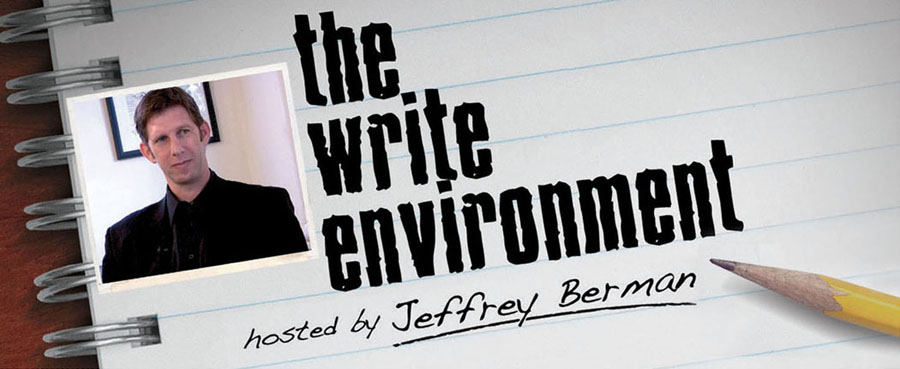
If you are in the Los Angeles area you can watch The Write Environment on KCET every Wednesday night at 10pm and again the following Saturday evening at 11PM. KCET's press release Announces New Program Schedule Wednesday is Drama Night. At 8:00 p.m., Robert Vaughn stars in Hustle, about a grifter who works with a team of con artists with a conscience in England. Then Helen Mirren stars in Prime Suspect as the tenacious, difficult and brilliant Jane Tennison, a no-nonsense British detective for Scotland Yard. Next, The Write Environment features local filmmaker Jeffrey Berman as host of one-on-one interviews with prolific screenwriters. Jeffrey Berman hosts this series of programs that provides an insight into the creative process by talking to some of the most influential writers in the entertainment business. This week's guest is writer/director Joss Whedon, who is one of the most prolific figures in television. You can find out more and keep track at KCET's website. http://www.kcet.org/shows/write_environment/
This article is long overdue. I haven’t blogged much lately because I’ve been busy developing a new series called Naught For Hire, starring Bern Browder. I won’t take up anytime discussing the show just now but if you’d like to learn more about it check out www.naughtforhire.com. In the meantime…
If you’re a comic book reader, like me, you have to agree that the industry has reached a new golden age. Especially now, when the Hollywood has reached the point where they can faithfully adapt the mainstream stories we’ve been reading for years, even decades and still find time to adapt some of the lesser known, independent comics. There has never been a better time to be a fan of comic books.
Which brings me to an interview I did with the writer of the best comic to be adapted into a film this year, so far… Kick-Ass.
Created by Mark Millar ("Wanted") and John Romita, Jr. ("Spider-Man"), Kick-Ass is the story of an average high school teenager who decides to put on a costume and fight crime as a real life superhero, and runs into real world bad guys who beat the crap out of him. And by that I mean two broken legs, a ruptured spleen, a collapsed lung and some serious head trauma. And that’s just the end of issue One of this eight-issue limited series.
Not your traditional comic book superhero.
But then, Mark Miller is not your traditional superhero comic book writer. Multi award-winning writer Millar has revamped the X-Men, launched a number one Spider-Man title, brought Captain America into the 21st Century and made Superman a communist. He is also the writer of the US industry's biggest-selling comic book of the past decade, Marvel's Civil War, published in 2007. His Wanted comic series was the industry's biggest-selling creator-owned book of the last ten years until he smashed his own record with Kick-Ass, each issue selling more than Spider-Man and X-Men from issue one with an unprecedented five printings every issue. Both properties were sold as movies before the first issue hit the stands and everything Millar has ever created is in various stages of theatrical development.
During the premiere of Kick-Ass, I had the good fortune to speak with this non-traditional comic book writer. And being a non-traditional interviewer I promised I wouldn’t ask any of those softball press junket questions such as “If you could be a Superhero what power would you like to have?” Instead, we dug deep into the nitty-gritty of what it means to be a superhero in the real world.
Jeffrey Berman: At some point over the last few decades’ comic books, yours in particular, abandoned fantasy for grittier, adult oriented stories that more often than not reflect real life. What is it about those themes that resonate so much with you?
Mark Miller: Well, I think it is quite interesting that before my career took off, and for quite a long time, nothing really happened. I was getting short gigs here and there on books that were just about to be canceled and I would maybe get a short run on things here and the stuff was quite well received but never really resonated with a mass audience the way that every writer supposedly wants to do. And I think what I was doing is that I was influenced by my comic book collection as opposed to being influenced by the world outside. Then I read this interview with Stan Lee, which I found very interesting, it was an old interview with him, and he was talking about what made Marvel and DC very different was that Marvel Comics were one DNA strand away from the real world and it was supposed to be the New York outside his window he was writing about with these fantastic characters in it. And at that point something switched on with me. It was around about the year 2000. I was making the jump from Superman Adventures, which I loved writing but it was a children’s book you know, like a fairy tale book. And jumping over from that to The Authority which was very grounded, earthy super heroes in the real world book and that was when I found my style. The way that artists have a particular style whether it is cartoony or surrealism or whatever I think that’s where I found the style that I was most comfortable with. And instead of looking back at old comics which I loved I tried to look ahead and think what would get the next generation into it.
JB: Starting with The Authority and moving forward from there, is it safe to say that your work is really characterized by a hard-edged cynical view of the superhero world and of the superhero himself?
MM: Um... it is funny because I never really think of it as cynical but I think your readers know your work a lot better than the writer does, as kinda like the way your family members know you better than you know yourself. And that is the thing people seem to take away from my stuff, that it is kind of dark or cynical or political and it is weird because I do not think of myself as that type of person. But maybe that is just a slightly skewed perspective, that someone, a foreigner essentially, dealing with American icons brings to it. We maybe look at people in uniforms with ultimate power with a lot more suspicion than Americans do. I think Americans have a really healthy optimistic attitude and I think sometimes that can be taken advantage of. Generally speaking, I think Americans tend to look up to people in uniform, whereas in this country, we are a little bit suspicious of anyone in power. So I mean that is only my own personal theory of why we maybe look at super heroes a little differently than you guys.
JB: You have to admit that Kick-Ass is a very violent book. In my opinion, extreme violence seems to characterize a lot of the work you have been doing lately.
MM: Well it’s quite interesting actually ‘cause again I am too close to really notice, but when I look back it is quite interesting. One of my relatives showed me that every image was like Wolverine slashing a Hulk in half for something or Apollo flying through a giant man’s head, you know that kinda stuff. Oh my God, that is something like a serial killer would come up with, you know. I think of myself as a very nice healthy person, you know, and I was quite disturbed when I saw it. I think of myself as quite charming and it’s funny. Growing up as a Catholic I suppose my earliest imagery I saw around the house and in the church was of someone being crucified or someone being flayed or whatever, you know. So I think we are very comfortable with very disturbing imagery. I have noticed this amongst a lot of Catholic writers, like Frank Miller.
JB: What I enjoy about the independent projects you have been writing lately is that there is a very strong sense of realism which started with The Ultimates, where you took superheroes that had been in that world and said whatwould they be like if they were real people today. Looking at your work, what do you think is the next level of realistic super heroes? Where do you go with them from here?
MM: I think your cast is part of a wave actually, you know. You have the golden-age characters, which I adore, Superman, Batman, Wonder Woman, all your classic characters. And then you have your Atomic-age characters, you know, your silver-age characters, like the Marvel characters. You got either the re-inventions of the beefy characters and the stuff that (Joe) Simon, Jack (Kirby) and (Stan) Lee created. Then you sort of get your image characters which they never quite caught on, but they do belong. They were huge in their day and I think we always forget just how big those things were. At the time they were really as big as Spiderman was back in the sixties. Things were selling millions of copies. What I see now is a gap in the market essentially. I think everyone has been waiting for the next generation of superheroes to come along. They’re re-inventing Spiderman with Ultimate Spiderman, re-inventing The Avengers with The Ultimates. And I think that people are looking for something new. I was quite surprised how big Wanted was when I wrote the comic, because it was the first creator owned thing I tried and it out sold Spiderman. And then Kick Ass came along and out sold Wanted. I don’t even know if it’s because if they are technically good or they are sort of fulfilling a need. That people are looking for the post-millennial superhero now… they’re looking for the next thing. So what I am trying to do now is to create a whole wave of these in the same way that Stan and Jack did back in the sixties. To write them all within a few years of one another and hopefully get this generation a big library of super heroes.
JB: Do you think visually when working on a script or does story come first with you?
MM: Oh that’s a really interesting question because people who work as novelists and try to do comics find out it is different than writing a book. Whereas screenwriters adapt to it very well because it is a very similar discipline. Although I think it is even tighter than screenwriting because you can have people chatting for three minutes and it is fascinating. Visually it is interesting because the actors keep it together, but if you have a whole issue of two people talking it is eventually very dull. In comic books something interesting, visually interesting has to happen every few pages. So I think you almost write comics as an artist, I think it is a weird thing for a writer to say but I think it is eighty percent visually driven. A great writer can be destroyed by a bad artist, but a great artist can make even a rubbish story look good. I would say I probably have three or four big visuals in my head before I start writing anything and I always like to give at least two big moments every issue.
JB: I would agree with your assessment about the talking heads in comics for every writer except probably Brian Michael Bendis, who can do an entire book of people just talking to each other and get away with it.
MM: Yeah, luckily he is so good at dialogue he can get away with that. Guys like him are the David Mamet’s of comics.
JB: Do you find yourself constantly being forced to push the envelope with each new project that you write?
MM: Only forced by myself, because I get bored really quickly. If you noticed, most writers stay on something three, four, five years as a nice steady paycheck. But I got this weird thing that I fire myself every year. I never stay on anything more than a year and I hate the idea of resting on my laurels. Some friends I have had have said, “Oh you know you should stick around for a few years and even the bad patches you learn from and then suddenly you find a whole great new section of your arc.” I just feel comics are so expensive that I want every page to be as good as it can be. I try to make every issue visually exciting, filled with story content and everything and just as I am exhausted I move on to a whole new series.
JB: When writing books like The Authority or The Ultimates do you equate violence with realism?
MM: I think violence is realistically what’s going to happen if you put on a costume and go out looking for trouble. Whereas if I was writing a story like American Jesus perhaps for example, the realism of being a twelve year old boy in the American Mid-West is probably very non-violent. At best there is probably going to be a scuffle once a year or something like that at school. But generally speaking it is just you walking around talking to your friends and maybe playing video games or something. To me the realism comes with the situation. Something where the guy is putting on a wet suit and going out looking for gangsters, you know, in one night you are gonna end up with the most horrific violence and end up in an actual emergency.
JB: What is your writing process? How do you work? Do you start with an outline? What is a typical day for you?
MM: Actually it is kind a weird, you know. I really enjoy it but somebody described it as passing a really difficult stool and I think that it is an accurate description of it. Because you know you know that the story is there, you are just trying not to fuck it up. You don’t always succeed at that. It is kind a like the story exists and you are just dusting away at it like an archeologist and you are just trying to raise it out of the ground without breaking it. The story I am working on now is like an eight part story that I am just starting today. It’s all there. What I do is just start drawing little scenes and good visual moments. The sort of stuff you would be chatting about if it was a movie and you were walking out of the cinema with your friend. I try to get the scenes, the moments together and then I organically start linking them and how to make it all work. And I know on some kind of sub-conscious level that they do all link together and then I start writing. The bulk of it is done pen and paper and then I write the dialogue and then I start to break it down over issues and edit so that a 29 page story gets down to the necessary 22. I am very ruthless with the stuff, cutting out scenes, cutting out panels, combining panels. Just until the structure is the way I want it to be. I think I am about half as fast as everyone else that I know that I work with, because most guys that I know just sit down and start typing. But I believe in it and I really put that much thought into it and I am there from nine to six every day. And I am amazed when I hear that the guys do four days and everything. I am amazed at how they do it because I get two books a month out if I am lucky and that is an eight hour day.
JB: How has your writing process changed over the years from when you first started working in comics?
MM: Probably identically actually. This is pretty much how I have always worked. I think it is like a muscle though, in a sense that the more you work it the better it gets. I have my own little short hand and everything. Like I used to note the very good action scenes. Now I just have this thing in my head if I storyboard it out on paper and make flow as simply and dramatically as possible, just editing and editing. I think action scenes are kind of one of my strong points, you know. So hopefully I have gotten better.
The best education I ever got as a screenwriter came from reading scripts. When I started out I read every script I could get my hands on. I still do. When I have the time. Screenplays also make the best reference material when it comes to analyzing and breaking down a scene, especially when you’re stuck on one of your own. So when you read as much as I do, you digest a lot of pabulum. But every once in a great while you come across a screenplay that sucks you in and demands to be read. A script that refuses to let you put it down, until you’ve read every word, from Fade in until The End, every time you pick it up. A History of Violence is one of those scripts for me.
Based on a graphic novel (comic book), the screenplay by Josh Olson was nominated for an Academy Award, a BAFTA, the WGA award, and an Edgar in 2007.
Which segues into this week’s topic. Adapting scripts from other mediums whether it’s a novel, a play, a comic book or a video game, is a different breed of writing. You would think it would be easy; after all, the story and character are already developed which leaves the writer the simple task of transcribing it for filming. You would think that… but it ain’t so. I know firsthand because I’ve written several adaptations, including an M.O.W based on a biography of J. K. Rowling and I can honestly tell you that it was more difficult to write than some of the original scripts I’ve written.
So when it came time to discuss adaptations I went to one of the best, and one of my favorite writers: Josh Olson.
Writer of the cult movie, Infested, Olson broke into the studio world when he sold his original script Three Guns Blue to Paramount Pictures. That led to his first studio assignment, adapting the graphic novel A History of Violence. Since then, Olson has collaborated with legendary author Harlan Ellison on an adaptation of Ellison’s “The Discarded” for the ABC TV Series Masters of Science Fiction. He’s also worked on adapting the hugely popular video game HALO for producer Peter Jackson and has adapted the Dennis Lehane short story Until Gwen, which he will also direct. Additionally, he contributed the script Have I Got Story for You to the smash hit Batman: Gotham Knights project. More recently, Olson wrote a sequel to The Wizard of Oz for Warner Brothers and has just finished adapting the Lee Child bestseller One Shot for Paramount.
He is currently developing a TV drama, Pleased To Meet Me, with the legendary guitarist Slash, and is writing the pilot for Meanwhile, a dramatic series he created and sold to producer Peter Chernin and the Fox Network. Olson can also be seen commenting on classic film trailers at Joe Dante’s website, Trailers From Hell.
His Village Voice essay, “I Will Not Read Your Fucking Script” became an internet phenomenon, getting upwards of two million hits, and is spawning a book. (I wonder who will adapt it for the screen? Ed. Note).
Jeffrey Berman:How does the writing process differ when adapting a screenplay from a book versus working on an original idea?
Josh Olson: Every script is its own thing, whether it’s original, or an adaptation. There are no set rules to any of them. I’ve done adaptations where I’ve only read the source material once, and I’ve done them where I had the book open in front of me every step of the way. Hell, the writing process differs from page to page, let alone project to project.
JB: With a comic book like A History of Violence you obviously have less material to draw on then you would a novel or a series of novels like Oz. Does that allow you the freedom to develop original material or is there a fear of straying too far from the source? And does that make your job easier or more difficult?
JO: It’s not about the quantity of material. It’s about the material itself, and what you’re going to do with it. With History, I took John Wagner’s premise, title, and - god help me for using this phrase - “inciting incident,” and then leapt off and told my own story.
The graphic novel was packed with story, it just wasn’t a story I wanted to tell. It’s a solid, smart and fun action thriller, but I was a lot more interested in getting into questions of identity. In the book, there’s never a moment’s doubt that the main character is the man the mob guys think he is. I felt like that was a missed opportunity. I thought it was a great chance to play with a classic “wrong man” scenario in which the wrong man is actually the right man. And that led me to start thinking about identity, and what it is that constitutes your “self.” Is Tom the guy they all say he is? Or is he the guy he’s made himself into?
The freedom to stray from the material doesn’t necessarily come from the material, but from your own response to it. It also has something to do with the studio’s needs, as well. If you’re doing Harry Potter, there’s a billion fans that the studio’s trying to serve. If you fuck around with the fundamentals of the stories or the characters, you’re gonna be out of a job. But with something like History, we were talking about a ten-year old graphic novel that had a very small print run. There wasn’t a market-driven imperative to be faithful to the material, and it wasn’t the enormous audience that compelled the studio to purchase the book. I found out when they hired me off my pitch that they’d had the same concerns with the book that I did, and had just been waiting for someone to come in and show them how to take it into a completely different direction.
In the end, it’s gotta be a story you want to tell. I’ve written a lot of originals, but in the end, History was one of the most personal scripts I’ve ever written.
But, like I said, it’s not about quantity of material. I adapted Dennis Lehane’s short story Until Gwen a while back. It’s a 15-page story, and it’s very spare in terms of plot and detail. It’s mostly flashes of memory, tiny details, and bursts of emotion. Very little to work with, in terms of traditional scenes, but one hell of a powerful story. For the screenplay, in order to create a feature length narrative film, I had to invent most of the scenes, many of the characters, and find a way to structure it as a visual narrative. In terms of what a screenwriting 101 teacher would call “adaptation,” there’s maybe 20 pages of the thing that are directly based on Dennis’ story. However, from the first page to the last, I was being absolutely faithful to Dennis’ story and his vision, at least as I saw it.
That’s what it boils down to for me - writing is all about taking what I see and feel and communicating it to you. In the case of an adaptation, it’s about showing you how I saw something. Because I’ll never be able to really know what Dennis’ real vision was. All I can do is tell you how I connected to it, and hoped that it touches and moves you. In the case of something like Until Gwen, I’d also hope that it would inspire you to seek out the source material and let it have its way with you as well.
JB: When adapting a classic story like Oz, how closely do you keep to the source material and how important is that for any adaptation?
JO: Like I said, they’re all different. There’s no way to generalize about any script, adaptation or original. I wasn’t adapting a specific book, but I wanted to get across some of L. Frank Baum’s magnificent characters and settings, as well as write a movie that could stand as a sequel to the MGM classic. The story I sold Warner Brothers was my own story, utilizing characters and settings and information from the first few Oz books. The hope was to come up with something that would work as a sequel to the movie as well as satisfy fans of Baum’s world.
With the exception of the characters from our world that I created, every character in the script is from Baum. But I put them into my own story.
JB:Before you start to adapt a novel for the screen, such as One Shot by Lee Child, how do you determine what parts of the story go into the script and what parts are left out? And why is it necessary to leave anything out?
JO:One Shot was a project where my mandate was to introduce a very popular fictional character to a movie audience. In that One Shot is actually the ninth book in the Jack Reacher series, it necessitated changes that would allow us to make this the first movie. But beyond that, there’s almost always some basic nuts and bolts things that have to change. In One Shot, for instance, the book is paced rather leisurely. Jack spends a lot of time going back and forth between the same two or three locations, and while it works great in the book, it would have left us with a very static movie. I had to come up with ways to combine the net result of several scenes into one, all while not just being faithful to Lee Child’s fantastic character, but also introducing him to a larger movie audience that won’t be familiar with him.
JB:What advice would you offer to writers who are driven to find stories from other mediums to adapt as feature films?
JO: We’re at a point in the film business where it’s harder than it’s ever been to sell originals. We could discuss and argue the reasons for this ‘til the cows came home, but in the end, it wouldn’t change that fact. Studios are heavily invested in doing material that has some semblance of built-in recognition. The trick, for me at least, has been to find material that I click with personally. In the case of Until Gwen, it was a short story that just gutted me. In the case of History, it was a premise that allowed me to take the story into an entirely new direction and explore ideas that are of deep personal interest to me. With One Shot, it was a chance to fill a void I’ve been feeling for many years - the absence of smart, American tough guy movies. The book came to me the morning after I’d shown my girlfriend the first two Dirty Harry movies, and we’d talked about how sad it was that no one was making movies like that anymore. With Oz, I got to take books that I loved as a kid and use them to comment on the state of imagination today.
People often perceive adaptations as somehow easier than originals... “coloring between the lines,” if you will. But if you find the way into them, the way to make them personal to you, they can be as challenging as satisfying and as difficult as an original. Sometimes more so. The vast majority of directors don’t write their scripts. In essence, they’re adapting someone else’s work, translating a singular vision from one form to another. It’s all a challenge.
If you are a regular reader of The Write Blog you've probably noticed that the frequency of my posts have diminished over the last month. Take heart in that it's not for the lack of desire or that I've run out of writers to interview(I don't foresee that happening anytime soon)... the truth is I've been engaged to write and produce an educational film that has consumed a great deal of my time due to a very tight shooting schedule. That said, I hope to be back to posting new interviews as soon as next week.
In the meantime, I wanted to update you on an interview I posted Tuesday, August 18, titled, "After The Fall Juliet Landau Takes On Angel" I recently received the following note from Juliet that I promised to pass on to my readers.
Hi Jeffrey ,
How are you? I hope all is great!
I am excited to let you know that Issue 2 of the Drusilla comic I co-wrote is now out! I am attaching the two covers I designed for this issue and a few photos from the bonus photo gallery that runs inside.
Hope to catch up real soon!!
:) Juliet
So, if you haven't done so yet, head down to your local comic store and pick up the second part of Juliet's story. And if you haven't read the first part, pick that up too. Then come back here and reread my interview with her. Then drop me a line and let me now what you thought of it. Who knows, if I find something of interest in your comments I may just pass it along to Juliet.
One of the downsides to working as a writer in the entertainment industry is that writers are often pigeonholed into one style of writing; as if someone who writes science fiction films can’t handle a strong dramatic period piece. It’s frustrating because a good writer doesn’t want to keep writing the same story over and over again just as a good actor doesn’t want to continue playing the same role from one film to the next. It’s a vicious cycle in Hollywood; the machine wants to suckle the success formula until its bone dry.
For many years all I wrote were high concept comedies because that was the genre of the first script I sold. It was expected and incumbent on me to continue doing what I did best, without any thought of doing what I wanted to do most. That is until I wrote my first suspense thriller, which my agent at the time assured me would sell for seven figures. When it didn’t the agency dropped me. I was hardly discouraged. In fact I followed that script with a youthful action period piece which was immediately snapped up by a network as a series and ended up affording me the opportunity to sign with an even better agency. This eventually got me a gig writing a serious bio-pic for one of the most lauded authors of our time. Not bad for a comedy writer. Of course I still write comedies. I’ve even written a pilot for a romantic sitcom on spec recently, but not because someone was demanding it from me, but because it’s what I was driven to write. The point is a good writer will always rise to the top no matter what the genre. And while some writers do like to stick with a formula they know best, others like to stretch their talent and take chances.
The same can be said for actors, too. It’s just as difficult for Adam Sandler to be taken seriously, as it is for Meryl Streep to be seen as funny. But that hasn’t stopped them from making the effort. This brings me to this week’s interview with Juliet Landau. Lately, she’s been making that effort… and then some.
Yeah, we all know she’s famous for her role as Drusilla, the psychotic vampire on BUFFY THE VAMPIRE SLAYER and ANGEL,butshe’s not just a one trick pony. In addition to being an accomplished TV & Feature Film actress, she’s also proven her worth as a voice actor and lent her talents to projects such as Ben Ten: Alien Force, Justice League and most recently Green Lantern First Flight. But that ain’t all, because Landau recently made a name for herselfas the director of TAKE FLIGHT, her documentary about Gary Oldman’s music video for the band Chutzpah and for co-directing the Godhead music video HERO, which Landau also appears in. More recently she wrapped production on an adorable new kid's movie called Monster Mutt.
So let’s see… she acts, she directs and now move over literary luminaries because she also writes. That’s right, Landau has become a triple threat by branching off into the comic book milieu with a two-part installment of the ANGEL series centering on Drusilla, co-written with IDW scribe Brian Lynch. So with all that in mind, I was curious how someone with her background and talent made the transition to writer so smoothly.
Jeffrey Berman:Angel #24 is the first comic you’ve ever written, so how did you approach writing the book?
Juliet Landau: I was really excited when Chris Ryall and Brian Lynch approached me to do it. I had read all of the Angel and Buffy comics. As I hung up from our initial phone call, the idea came to me. I wrote it in script form (Final Draft) and they loved it so we progressed from there. Next, I asked Chris to send me a few of the previous issues’ final scripts. I compared and studied them against the printed comics, so that I could learn the formatting, structure, number of panels per page etc…
I wanted to play with certain themes. A significant one being, order versus chaos. The doctors/the Institution think they have all of the answers, but Dru’s very existence defies that. She’s a character that cannot be reined in. I also wanted to play with the visuals, to further the story. The Institution and the people in it are cold, sterile, stark. Drusilla is the most vibrant element in each frame. Even though she is undead, she is more alive than the world surrounding her.
JB: The two issue arc centers around Drusilla. A character, it’s safe to say you’re pretty familiar with. So what did you bring to the script from an actress’ perspective?
JL: It was fantastic to revisit Drusilla. I think I brought a core emotional understanding of the character, especially in Issue 2, as Issue 1 is primarily the set-up. Dru’s history is dark and complex. I don’t think that she is often aware of what is motivating her, but I as the actress in the show, had to be. The audience made the connection, and in this case, the reader does. We all act out, based on our past (to lesser degrees, I hope!). I think it was because of having played her, that I was interested in exploring that reservoir.
JB:Before you began writing the comic book did you do any research or speak to any other writers in the industry and if so what advice did they give you?
JL: I sort of jumped in. I was working with Brian Lynch, who had written all of the previous Angel: After The Fall books. He is an incredible talent.
JB: What did you find was the most difficult part of writing the story and how did you work through it?
JL: There was a particular thing at the end that kept niggling me. I did what I do in any creative venture… I think about it relentlessly until I get the answer. I work it and re-work it mentally until I know the way I want to go. I have been branching into all kinds of creative areas. I directed Take Flight, a short documentary film about Gary Oldman (julietlandaustakeflight.com) and co-directed Godhead’s Hero music video ( HYPERLINK "http://godheadhero.com/" http://godheadhero.com/). Whether acting, directing or writing, I find my creative process to be very similar.
JB: What did you learn about being a writer from this experience and do you plan on writing anything else in the near future?
JL: I loved it! Working in this medium really forces you to think visually. It is about communicating a lot economically, with visuals, not with words. I really like that anyway, in movies/theater because behavior communicates volumes. I have written a short film called “It’s Raining Cats and Cats,” in which I will play seven different characters and I adapted a piece that I worked on at the Actors Studio into a short as well. I wrote those prior to the Dru comics and I definitely look forward to writing more!

 Posts
Posts


